Santiago, Chile Research publication / 2021
Chile
despertó!
An analysis of
the Primera Línea
A digital reading edition of the October 2021 publication.
Sobre este proyecto
About this project
This analysis is intended to draw attention to a protest that is underrepresented in the Western media - the protest of the Chilean people. It is largely based on the elaboration of internet sourced video material but also on personally collected impressions on the ground.
We have tried to create a work that is as comprehensible as possible, with the aim of generating attention for the topic. Despite our efforts, we are aware that our elaboration is more a tracing than an all-encompassing comprehension of the situation from the inside. In other words, the reality of our lives and the resulting view from a Western European country does not allow us to claim empirical truth for our analysis.
To work on a project like this and depict, e.g. the weapons and ammunition of the armed state police as accurately and in as much detail as possible, is almost cynical when you consider that what you have just illustrated may have been used to kill people protesting. It is sometimes difficult to grasp, but enormously important to understand, that what we have worked on and what we had a look at, from an outside view, is the reality of many other people's lives.
Some of the objects and situations we have illustrated and described may be visually appealing, but the actual situations on the ground are not. Gustavo Gatica's statement: ‘Regalé mis ojos para que la gente despierte’ - ‘I gave my eyes so that people would wake up’. is not a subjunctive.
In the protests, Chile's people have to fear every day anew that they will fall victims to the violence inflicted by the state. They risk their lives on the way to more dignity and a better future. At this point, our project may be over, but the history of the Chilean people is still being written.
Introducción
Introduction
Since the 18th of October 2019, people in Chile have been taking to the streets. What started out as a 30 peso (3 cents (€)) increase in metro ticket prices in Santiago de Chile quickly turned into the largest nationwide protest in Chilean history. The protest, which was initially directed against the rich elites in the country and the high social injustice, developed over time into a concrete demand for a new constitution. But even after a referendum was held in favor of a new constitution, the protests did not cease completely.
The first actions were triggered by students of the Universidad de Chile, a university that had already attracted attention in the past due to student protests. The students called for a boycott of the payment of tickets and decided to jump over the turnstiles of the metro entrances as a form of mass civil disobedience. Chile has a long tradition of student movements protesting on behalf of the working population.
In 2019, the students succeeded in taking the protest out of the sphere of influence of the universities and began to expand it to other parts of the population. The conflict continued between the super-rich elites and the people who are disconnected from the political discourse.
The brutality of the Carabineros de Chile commanders' (more about the institution of the Carabineros can be found in the chapter ‘The Cops - the Carabineros de Chile’. The Carabineros, popularly known as Pacos, correspond to what we know as the police.) crackdown on protests in the metro stations sparked anger at the lack of awareness of the protesters' frustrations and demands. Correspondingly several metro stations were set on fire.
The public transport network was brought to a standstill in large parts of the city. As a result to that, the working population had no choice but to march home on foot. In a mega-metropolis like Santiago, with 5 million inhabitants, it already looked like a large-scale demonstration, when the working population was making their way home on foot.
Even though these walks were actually based on the need for mobility in the city. For many Chileans, the commute to work takes over an hour in a metro that is busy almost all the time. During rush hour, it is not uncommon for Chileans to have to wait for following trains to avoid being harshly crammed together. Contrary to what one might expect in Europe, the anger about the breakdown of the metro and the resulting delay combined with irregularities in everyday work, was not directed at the students who set fire to the metro entrances.
The working people blamed the private companies that control almost all areas of public life and annually increase the prices for electricity, water and public transport.
This is based on the fact that despite the continuous increase in the cost of living, the incomes of the working population have remained almost the same over the last decades and thus more and more Chileans of the middle class have been drifting into uncompensable debt.
The anger about the metro breakdown was not directed at the alleged ‘vandals’, but against the failed policies of the past 30 years, which is why the slogan ‘no son 30 pesos son 30 años’ - ‘it's not 30 pesos it's 30 years’ was increasingly used. The government seemed to have lost touch with the real lives of an overwhelming majority of the population, while at the same time politicians were enriching themselves on the backs of the entire Chilean population.
When President Sebastián Piñera, one of the richest Chileans ever, responded to the unrest in a televised speech, he claimed to be ‘at war with a powerful enemy’ and declared the state of emergency right after that speech.
This response to the actions of the protesters, who did not see themselves as enemies but as ordinary Chilean citizens, brought the barrel to overflow. ‘No estamos en guerra - estamos unidos’ - we are not at war, we are united - was the slogan under which they gathered all over Chile.
For the first time since the bloody Pinochet dictatorship, the military was on the public streets and intervening. This led to the largest nationwide protests in Chilean history on 25 October, with more than 1.5 million people mobilized in Santiago alone. Contrary to past protests, where mainly students were involved, the images of the Chilean military in Santiago's streets awakened the unresolved history of the older generations.
They joined the young ‘generation without fear’, who had not experienced the atrocities of the Pinochet dictatorship themselves, and demanded not only the reversal of the increase in metro fares but profound reforms. Hence a protest movement without leadership developed. People who had lost all trust, even in the opposition, united their demands as a common disposition of departure ‘por un Chile mejor’ - ‘for a better Chile’ and ‘una vida en dignidad’ - ‘a life in dignity’.
Thus, different groups demonstrated together on the streets for different reasons. Old people, for example, demonstrated mainly against the unjust, private pension system AFP. Women, who lead a very large, significant part of the demonstrations, protested for more equality, against ‘el machismo’ - ‘the male chauvinism’ and for a legal, safe and free abortion. The Mapuche, an indigenous group, that is also supported in their concerns by a large part of the population due to their ethnic affiliation, protested against their systematic oppression and the rightful preservation of their territory.
Young people started demonstrating for free education, equal opportunities and the abolition of the many neo-liberal principles enshrined in the constitution, that date back to the Pinochet dictatorship.
In addition, there are relatively young orphans who are fighting because they have nothing to lose anyway. These are not students or normal pupils, but kids who have been abandoned by politics and systematically abused by the Chilean state body called SENAME (Servicio Nacional de Menores). All together they support each other's demands and among each other they share many, such as ‘aguas libres’ - the de-privatisation of Chile's water resources.
Whole families were able to join the extremely creative, colorful protest, which was accompanied by music, dance, theatre and a new social framework developed within the communities. The ignition of these large protests and the associated riots are known in Chile as ‘el estallido’ - ‘the explosion’ - and illustrate the enormous force through which a new scale of protest suddenly emerged.
Led by a generation without fear, which is ready to fight for fundamental social change in the country, since 2006. This project focuses precisely on ‘la generación sin miedo’ - this ‘generation without fear’, which organized itself in non-hierarchical, heterogeneous groups, to facilitate the kind of protest that reflected the totality of the Chilean population. A front developed that rose up against the repressive powers of the Chilean state - la Primera Línea.
Our concept is to highlight the actors of the Primera Línea and to examine their interaction within space and with each other. The analysis refers to concrete spatial relationships, but also to the atmosphere, the tools used and interpersonal interaction. In this way, we will break down a network that seems chaotic at first glance, but slowly the roles of the individual actors will become clearly comprehensible.
Línea de tiempo
Timeline
The following pages illustrate the political development of Chile within the last decades - by means of a timeline.
In order to understand the buildup of tension leading up to the outburst of the Chilean people, we have to travel back in time almost 30 years to the beginning of the Pinochet dictatorship. The dictatorship in Chile was the result of a military coup by General Augusto Pinochet, who brought down the socialist government with the massive support of the U.S.A.. A large part of the Chilean population witnessed and/or fell victim to violent crimes committed by the military, whose goal was to establish a neoliberal economy and eradicate socialism.
These experiences became anchored in the collective memory of Chileans. The political and economic reforms allowed a few investors, some of them foreign, to enrich themselves on the Chilean market.
Increasing privatization, which did not even stop at the basic right of free disposal of water, plunged many Chileans after a small peak into serious poverty and caused fundamental deficiencies at the social levels of society. Indigenous populations such as the Mapuche were particularly affected by this social change. Health care, educational opportunities, social programs, and the pension system consistently eroded with the increasing capitalist development of the market, while a small number of upper class, wealthy investors managed to gain a great amount of power and influence.
Many of these influential investors expanded their activities into the political sphere, driving the country and its people further into abyss. Simultaneously, the discrepancy between the life of politicians and the actual reality of life for the majority of the population grew even further.
Confidence in political instruments to bring real change declined continuously, which can be seen in voter participation rates. Many Chileans consider the old constitution from the time of the Pinochet government to be one of the reasons for the country's social deficiencies. The escalation up to the explosion 2019, which puts all previous protests, in terms of their size and impact in shade, could be due to the fact that the President Piñera has declared a state of emergency during ongoing protests and therefore ordered military forces in the cities.
The presence of military units that suddenly appeared everywhere in urban areas and intervened in the protests, awakened memories of the military dictatorship in the population and added fuel to the fire of the newly sparked uprising.
The following timeline illustrates the individual key events before, during and after this explosion of protests and visualizes the successive events in relation to one another. Less with the claim to completeness, but with a focus on the most important elements to be able to classify and understand the overall event.
La prehistoria
The prehistory
11 Sep 1973
Chilean coup d’état
a group of military officers led by General Augusto Pinochet and Admiral José Toribio Merino, highly supported by the CIA, seize power in a coup. president Allende refuses and gives his last speech vowing not to resign. later that day, Allende commits suicide. a dark period in Chile's history begins. today Allende is still considered a hero by many Chileans and is present at various protests in the form of banners and posters.
11 Sep 1980
A new constitution
a new constitution is approved by a controversial plebiscite characterized by the absence of registration lists. general Pinochet becomes president of the republic for an 8-year term. the constitution's chief architect is the right-wing intellectual Jaime Guzmán, a law professor at the Catholic University in Santiago, and a close ally of the Pinochet regime. he starts installing a super neoliberal economy with the help of the ‘Chicago Boys’. later on the post-Pinochet democracy outlined by the constitution would be forced to continue many of the economic policies the dictatorship had put in place.
1988
Plebiscite on another Pinochet term
according to the established constitution there has to be another plebiscite in 1988 in which the voters would accept or reject a single candidate proposed by the Military Junta. Pinochet is, as expected, the candidate proposed, but is denied a second 8-year term by 54.5% of the votes. various factors lead to Pinochet's decision to end his candidacy. among other things the situation in the Soviet Union, where Mikhail Gorbachev had initiated the glasnost and the perestroika democratic reforms.
14 Dec 1989
Election of Patricio Aylwin
Chileans elect a new president and the majority of members of a two-chamber congress. Christian Democrat Patricio Aylwin, the candidate of a coalition of 17 political parties called the Concertación, receives an absolute majority of votes (55%).
1990–2019
Transition to democracy
since there has been a peaceful return to democracy, the constitution has been retained. it was amended several times until 2020, but fundamental changes, e.g. to the economic system, are not implemented. the constitution served, again and again, as an impediment to social progress. important reforms have passed the Chilean Congress, and even been signed into law, only to be struck down by the Constitutional Tribunal, an independent court that rules on the constitutionality of legislation, as well as on Presidential and judicial decrees.
Apr–Jun 2006
“Penguins’ revolution”
announcement on April 24 of a new increase in fees for the PSU (admission test for students to apply at universities), rumors of a new restriction in the students’ transport pass. several public schools in Santiago organize demonstrations. the protests peak on May 30 when 790,000 students adhere to strikes and marches throughout the country. in June announcements of several new measures for education that meet most of the students' demands; announcement of a 73-member presidential advisory committee to discuss the students' long-term demands; student assembly accepts the invitation and calls for an immediate end to strikes and school take-overs.
Apr–May 2008
Student protests
a series of protests by citizens of dissatisfaction against the state of education in Chile. largest student protest in Chile after the 2006 student protest.
2011–2013
Student protests
series of student-led protests across Chile, demanding a new framework for education. beyond this, the protests reflect a ‘deep discontent’ among some parts of society with Chile's high level of inequality. protests include massive non-violent marches, but also a considerable amount of violence. protestors do not achieve all their objectives, but contribute to a dramatic fall in Piñera's approval rating
14 Nov 2018
The murder of Camilo Catrillanca
Mapuche Catrillanca is killed by a shot in the head, in the Mapuche community of Temucuicui, during an operation carried out by a special unit of the Carabineros. his death leads to protests and demonstrations in Santiago and other cities.
El estallido
The outbreak
6 Oct 2019
Price hike announcement
+30 pesos for Santiago metro tickets. students are outraged because working-class families like theirs shoulder the extra cost
6 Oct 2019
Mobilization for protest
a few hours later classmates are on WhatsApp, organizing a walkout for the next school day
7 Oct 2019
First action
180-200 students jump the turnstiles filming with their phones
8 Oct–14 Oct 2019
Actions spread
action is spread by hyper-connected teenagers of Santiago, with texts, Instagram posts and WhatsApp groups amplifying the news. young people are jumping the turnstiles at metro stations all across the city
15 Oct 2019
School closing
in response to a fire caused by a Molotov cocktail, classes at the National Institute are suspended for three days. the first metro stations are closed.
18 Oct 2019
Metro closing
the situation escalates, barricades are built, to which the police responds with water cannons and tear gas, the transportation minister, Gloria Hutt, abruptly orders the metro closed. people start walking home on the streets
18 Oct 2019
A relaxed Piñera
while riots continue in Santiago, a customer of an expensive restaurant posts photographs showing a relaxed Piñera on the birthday of one of his grandchildren eating inside and his private escort convoy sitting outside the building
18 Oct 2019
State of emergency announcement
later at night Piñera announces a 15-day state of emergency in the capital, allowing the armed forces to patrol the city alongside the Carabineros
19 Oct 2019
Riots spread
metro remains closed to passengers, shops are looted, buses are set alight and clashes occur between demonstrators and the security forces, Piñera announces the cancellation of the fare increase. Santiago curfew is imposed between 22:00h and 07:00h, rioting spreads to other parts of the country, states of emergency are declared in the Valparaíso Region and Concepción Province
20 Oct 2019
War announcement speech
Piñera gives a speech declaring to be at war with the protestors. protests continue, curfews are imposed for that night in the Santiago Metropolitan Region, and the regions of Valparaíso, Biobío, and Coquimbo. as the curfew begins in Santiago, many protesters remain on the street
20 Oct 2019
School closings
local authorities announce the closure of schools in 43 of the 52 communes of the Metropolitan Region and across the province of Concepción
25 Oct 2019
“La marcha más grande de Chile”
over a million people take to the streets in Santiago, and thousands more throughout Chile, to protest against President Piñera, demanding his resignation
27 Oct 2019
Resignation of politicians
Piñera requests all of his cabinet ministers to resign, he accepts 8 resignations
8 Nov 2019
Continuing protests, looting and arson
approximately 75,000 people take to the streets of Santiago to take part in anti-government protests. Roman Catholic church in Santiago is looted and its religious iconography is burned in the street
8 Nov 2019
Gustavo Gatica is blinded
Carabineros fire into the crowds aiming at the upper body of protesters, Gustavo Gatica, a 21-year-old student, is shot in both eyes and is blinded permanently. after this incident, many other similar cases are documented in which protesters appeared to have been shot in the eyes on purpose. the eye, thus becomes a central visual symbol of the protest.
Las secuelas
The aftermath
6 Jan 2020
Students disrupt university entrance exams
student protests over inequality and elitism, with some students blocking access to test sites and burning exam papers.
28 Jan 2020
The murder of Jorge Mora
Jorge Mora, a football fan and a social activist, is run over by a national police truck outside a football stadium in Santiago
29 Jan 2020
Resuming protests
protests resume catalyzed by various incidents such as the death of Jorge Mora
3 Mar 2020
First case of COVID-19
the Ministry of Health confirms the first case of the SARS-CoV-2 virus in Chile
8 Mar 2020
International Women’s Day
two million people on the streets of Santiago de Chile on international women's day. the protests consist of a two day feminist general strike, street protests and the feminist performance ‘Un violador en tu camino’, which gains worldwide fame after being presented on that day.
26 Mar 2020
Quarantine curfews
total curfew to 7 communes of the Metropolitan Region are imposed
Mar 2020
Protests dwindle
protests come to a halt due to the COVID-19 pandemic
Mar 2020
Graffiti removal
government agencies erase most of the graffiti and street art in downtown Santiago that has been drawn during the protests
3 Apr 2020
Piñera at an empty Plaza Dignidad
president Sebastián Piñera visits the empty Plaza Dignidad and takes some pictures on it, which is considered by many as a way of taunting the protesters under quarantine.
1 May 2020
International Workers’ Day protest
despite the lockdown, some protests appear during International Workers' Day in Santiago. that results in the arrest of 57 people by the Carabineros.
15 May 2020
Extended quarantine
Quarantine is extended to entire Santiago Metropolitan area
19 Aug 2020
Rollback of lockdown restrictions
the Chilean government announces a rollback of lockdown restrictions, but a nationwide night time curfew remains in effect
4 Sep 2020
First protest since lockdown
police and demonstrators clash at an anti-government protest at Plaza Dignidad, resulting in at least 20 arrests.
11 Sep 2020
47th anniversary of the Pinochet coup
47th anniversary of the Pinochet coup, protestors clash with Santiago police at the central Plaza Dignidad
18 Sep–25 Sep 2020
Smaller weekly protests return
in the following weeks, small protests appear again at Plaza Dignidad usually on Fridays and are severely repressed by the Carabineros.
2 Oct 2020
A teenager is pushed off a bridge
a police officer pushes a 16-year-old protester from the Pío Nono bridge to the Mapocho river. The minor suffers several fractures and concussion and is rescued by protesters. The situation sparks new protests on Saturday
3 Oct 2020
Strong protests are sparked again
first time since the start of the national lockdown that the Plaza Dignidad is taken by protesters
18 Oct 2020
Arsons
a year after the protests of October 18, 2019, individuals set a fire on the Parroquia de La Asunción in Santiago, resulting in the bell tower collapsing from the fire. two Catholic churches in Santiago are burned as well.
25 Oct 2020
Referendum on a new constitution
referendum on whether a new constitution should be drafted takes place. overwhelming majority votes (78%) in support of rewriting Chile's constitution
18 Nov 2020
Demonstrations demanding Piñera’s resignation
hundreds demonstrate in the capital demanding President Piñera's resignation with regards to police repression of the protests
Pregunta / tesis
Question / thesis
In the context of the increasing riots, also a media interest in the protest and its actors developed quickly. This media image is basically divided into two camps. On the one hand the independent protest-related online presence of various Instagram & Facebook accounts as well as groups in messenger services and on the other hand the reporting of the conservative-national press, in which to a large extent the voices of the politicians are reproduced. The positions of these two reporters differ contrarily. In the conservative-national press and also on behalf of the president, there is repeated talk of two different types of demonstrators within the protests. The peaceful democratic citizens and the violent vandals.
As a response to this, ‘la tele miente’ - ‘the television lies’ is a widely used graffiti. We would like to deal with this distinction into two possible protest groups in the framework of elaboration. Our hypothesis is that a distinction between these two types of protesters is fundamentally impossible. The different forms of protest are mutually dependent and supportive, and are interrelated both in space and in theme. In fact, the Primera Línea is not the violent front of the demonstration, but its shield, precursor, and part of the wholesome network that is in turn sustained by the peaceful demonstration.
What role does the Primera Línea play in the protests? Who are its actors and what influence does their presence have on the protest space around Plaza Dignidad?
Metodología
Methodology
In today's protest movements, the smartphone plays an increasingly important role. It is not only a constant companion and documentation tool for protest events, but also forms a network of socially entangled interactions.
Chilean youth, who grew up under the neoliberal economic system of the Chicago Boys, are strongly under U.S. influence and, similar to other technologized countries, are ultra highly connected via social media such as Whatsapp, Instagram, Twitter, and co. Events can be broadcast live on the relevant platforms at any time by almost all protesters. The often highly emotionally charged images that are posted and shared in turn influence further protest events, as can be seen on the timeline shown earlier.
During the first months of the protests, entire social media channels emerged that showed a different view of proceedings than the pro-government media. There are heroic promo videos of the Primera Línea, which also glorify the violent confrontations with the police, and again others, that similar to the ‘mainstream’ media try to negatively instrumentalize the looting and destruction associated with the unrest to the demands of the protest movement.
So in order to get your own picture, you can observe videos and photographs depicting the protest events over a period of weeks, even months, and that's exactly what we did. In doing so, we first saved some videos relevant to our thesis and watched them over and over again. Each time we watched them, we noticed something new, which we processed in different programs.
The most relevant videos on which we base our analysis can be traced with the help of footnotes, e.g. 1 in the list of sources. In this way, it is possible to understand the basis of our work for oneself. In the appendix, found in the list of sources there is a fold-out page with QR codes which lead to the most relevant videos, but beware - trigger warning: some of the pictures and videos contain very explicit/violent real footage and should not be watched in the presence of children.
In the beginning, our analysis was mainly related to the central location of Plaza Dignidad. Thanks to the Galería Cima livestreams1, which were actually set up as an art project, we had an ideal opportunity to observe the dynamics of movement on site in retrospect and a daily basis almost twenty-four hours a day. However, it quickly became clear that the analysis of the movements in the immediate environment of the general protest, would not be able to support our thesis.
Through a movement analysis in the form of a heat map, we were able to show that dynamic movements in the square decreased as the protest events increased. So we had to approach the subject matter differently.
By gathering various video recordings of the side streets, we manually portrayed the occurrence and the roles of the individual actors of the Primera Línea. This extremely time-consuming and sometimes psychologically stressful work enabled us to pursue our goal.
We then compared our visual findings with voices on the ground, from articles and interviews, and used them to present a broken down snapshot of the actions of individual characters in the Primera Línea. The observed situation is composed of the analysis of snapshots from the period November 2019 to March 2020 and takes place in the ‘Zona Cero’ in the immediate surroundings of Plaza Dignidad, the symbolic center of the protest.
Resultados
Results
Through the analysis, elaboration and compilation of the actors, we were able to establish that the Primera Línea forms a new typology of protest, which through targeted action makes a large diverse peaceful protest space possible in the first place. Its decentralized organization, fearlessness, and division of labor into different thematic and spatial areas makes it possible to assert itself against the hierarchical order of the state. In this project we have identified the following eight actors:
los-escuderos - the shield-bearers; los-penasqueros - the stone-throwers; los-honderos - the slingshots; los-mineros - the miners; los-antigases - the anti-gas-troops; los-hidratadores - the hydrating troops; los-medicos - the paramedics; los-punteros - the laserpointers;
In addition to the eight actors, the construction of barricades precedes everything else, in which all actors participate equally to initiate the protest. The barricade builders are thus not an actor in themselves, but a symbiosis of all of them. All the actors, in their specific tasks, help to make the peaceful protest possible. It is important to note that all actions taken by the protesters arise out of necessity.
The division of work among the respective groups, emerges from a new situation every day, which is why there is no single, clearly defined image of a group of the Primera Línea. Unlike the hierarchy of the Carabineros, there is no leader of the protest.
All of the actors involved decide, depending on the repression by the Carabineros, whether and in what position they want to be an active part of the Primera Línea. Personal attitudes as well as personal experiences with state power are decisive. A person who was initially pacifist, such as the shield bearer, can develop into an actively violent person during the protest process, or return to being a demonstrator who is completely apart from the front line.
The roles of the actors are not fixed but can change constantly during a day of protest. If the frontliners notice that there is not enough cover against the shots of the Carabineros, a street sign is dismantled and a stone thrower turns into a sign bearer and the other way around.
Therefore, there is no predefined strategy. Based on the repression by the Carabineros, different tactics develop over the days of protest according to experience and necessity.The Primera Línea actors also include another network of supporters of this form of protest - a broad part of the population approves of the Primera Línea's actions. In their eyes, the frontline actors are sacrificing themselves for the rest of the protest.
The repressive measures of the state were exhausted against the Primera Línea, and only in this way countless rallies, performances and other events can take place in the peaceful protest space. The ‘segunda linea’ includes people who cook for the Primera Línea, make music, take care of their needs and create a social fabric in the middle of all this chaos.
Through the protest, people have found each other who otherwise would never have met, which has created new dynamics far beyond the protest.
Lugar de las protestas
Place of the protest
The central place of assembly in Santiago is Plaza Dignidad. This is an important landmark of the city and officially bears the name Plaza Baquedano, but was renamed ‘Plaza Dignidad’ - ‘Square of Dignity’ by the civil mass during the protests.2 It therefore spatially symbolizes the central place of the demand for ‘dignity’. The oval square, with a monument to General Manuel Baquedano in the center, functions not only as a focal point for celebrations and riots, but also as an important transportation hub.
Some of Santiago's main streets intersect here. Among them are Avenida Providencia, Avenida Libertador General Bernardo O'Higgins (known as Alameda) and Avenida Vicuña Mackenna. There is also a tunnel entrance to the Costanera Norte highway in the immediate vicinity.
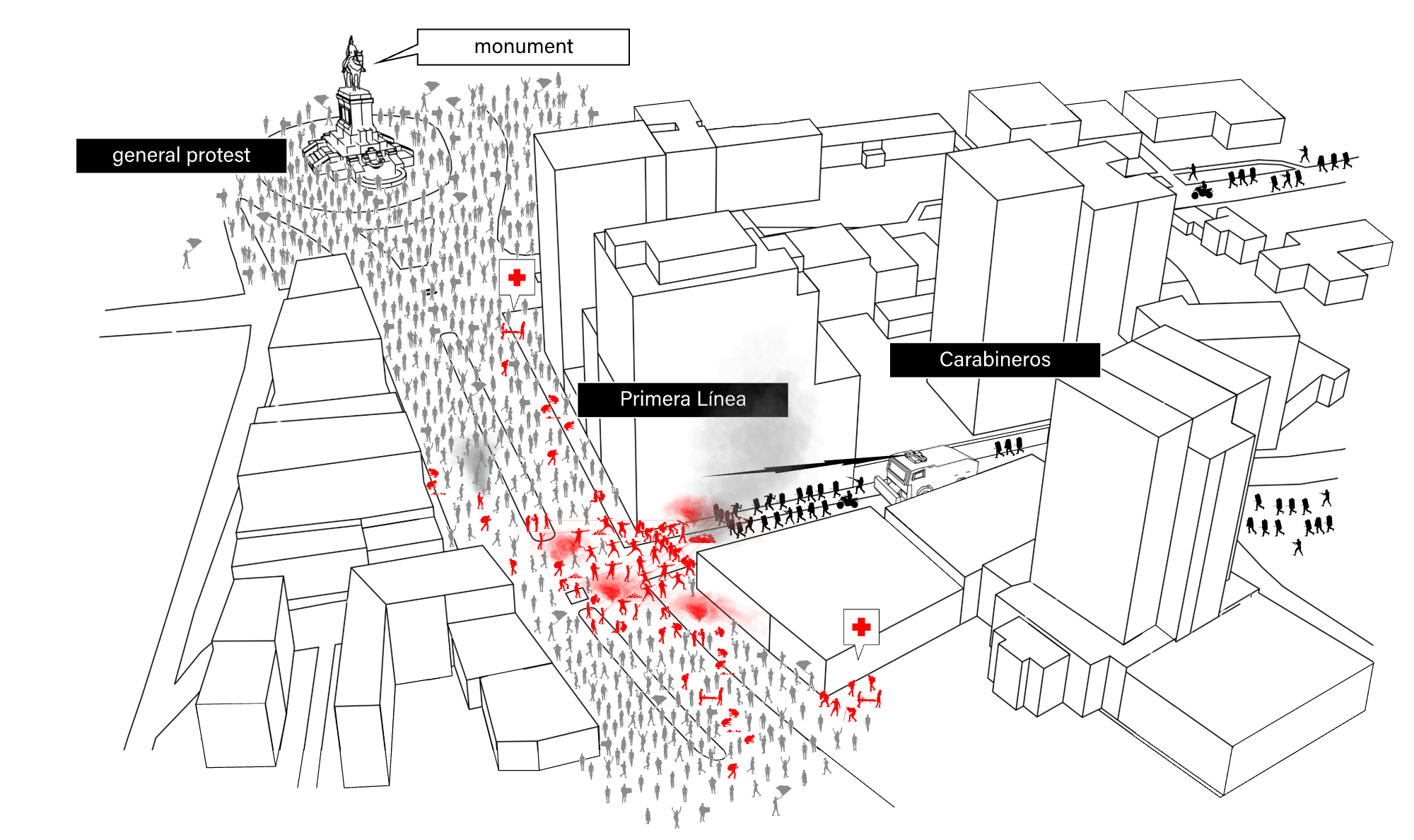
Furthermore, the city parks Parque Forestal, Balmaceda Park and Bustamante Park merge here in the surroundings of the square. As a large public space with a symbolic meaning and the possibility of paralyzing infrastructure (traffic), it fulfils ideal conditions to give meaning to the political demands of the protesters and to exert political pressure at this location. While the large ‘peaceful’ protest3 at the height of the protest takes place primarily in the center of this square, the confrontations between Carabineros and the Primera Línea are observed primarily along the access routes to the square.
The surrounding streets of the square are referred to as ‘Zona Zero’ and are important for our analysis of the protest events.
As shown in the movement analysis on the previous pages, the movement dynamics in the square continue to decrease as the protest action progresses. On the one hand, this is due to the surge of people and the opening up of physically empty space, but it is also related to the fact that the dynamic fronts of the confrontation shift to the peripheral areas in order to enable and maintain the protest events in the center of the square, as already described.
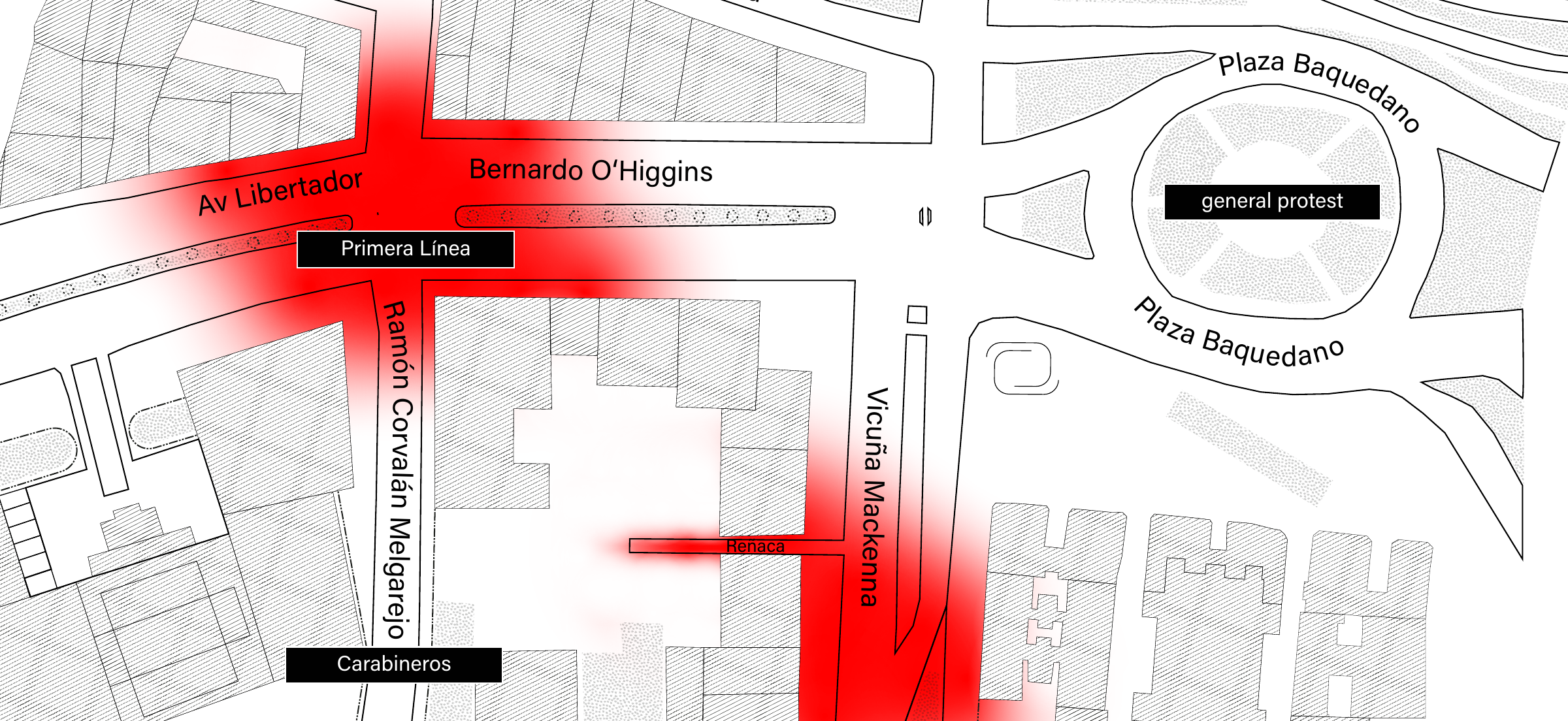
In our analysis, the central location for these confrontations of the Primera Línea was the intersection west of the square Av Libertador Bernardo O'Higgins - Ramón Corvalán Melgarejo and southwest of the intersection Vicuña Mackenna - Carabineros de Chile. This may be due to the fact that located about 1 km to the southwest is, among other things, the Department of Supply of the Carabineros de Chile. In comparison, a much denser cluster of police infrastructure can be located to the west of the square, than to the north or east of it. In our analysis, we will primarily focus on the intersection to the west of the square.
In principle, the Primera Línea is located in the periphery of the nonviolent protest. The borders between violent and non-violent protest are not static at any moment, but are constantly changing. As peaceful protesters participate situationally in frontline security, the transitions between those involved in the Primera Línea and the rest of the protest blur almost seamlessly.
With the help of 3D programs, we were able to recreate the exact local conditions and schematically enter the individual characters into the overall view.
Símbolos de la protesta
Symbols of protest
During the analysis of image- and videofootage, we noticed some recurring symbols that we consider interesting and relevant to the protest, from a design point of view. The symbols illustrate demands and also the orientation and composition of the protest’s participants. They shape the visual appearance of the movement within the media, as well as the environment itself, and thus also mirror the attitude of the movement.
Countless pieces of art can be admired in the streets of all major cities. A lot of the symbols also appear within the Primera Línea, as accessories or painted on objects. The following is a list of what we consider to be the most important symbols and their meanings.

white star on blue square, white & red strips. national flag of Chile.

same layout as regular flag but all black. aims to depict a general anti-nationalist feeling, showing the discontent from the people. symbolizes grief because the state of Chile tortures, kills and violates.

stepped cross border (Gemil), blue, green, red strips, yellow Mapuche drum in the middle (Cultrun), the flag of the indigenous Mapuche.

white star on blue ground. ancient Mapuche flag used by Mapuche troops during the early 18th century Arauco war.

green fabric with a print of two people with an ‘aborto ya!’ flag and the slogan ‘aborto libre, seguro y gratuito’. symbol of the feminist movement demanding free and safe abortions.4

black stray dog wearing a red bandana. acquired fame due to his participation in the street protests 2011. translation: ‘black cop killer’

symbols of eyes, often blood drips out, the pupil is crossed or eyes are blindfolded. symbolizes the many eye injuries during the protests.

cooking pot and spoon. Latin American symbol for a kind of protest that makes noise in the streets by banging pots, pans, and other utensils in order to call for attention.
Los actores y sus tareas
Actors and their tasks
The following pages illustrate the actors of the Primera Línea that we have highlighted. The analyses have been based on the viewing of hundreds of videos.5 We have then compared our findings with articles and personal opinions on the ground. However, we have mainly relied on open source tools and actual existing material to illustrate the actors and their props. This means that for each illustration there is an actual video or photo that can be found online.
Since the Primera Línea rose in all major Chilean cities, not all of these photos and sequences are from Santiago. In the context of our work however, this is not of great importance, since we show an exemplary picture of a constantly changing situation.
Las barricadas
The barricades
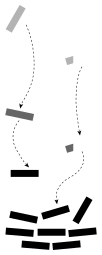
las barricadas are almost always built to initiate the protest.
Specification
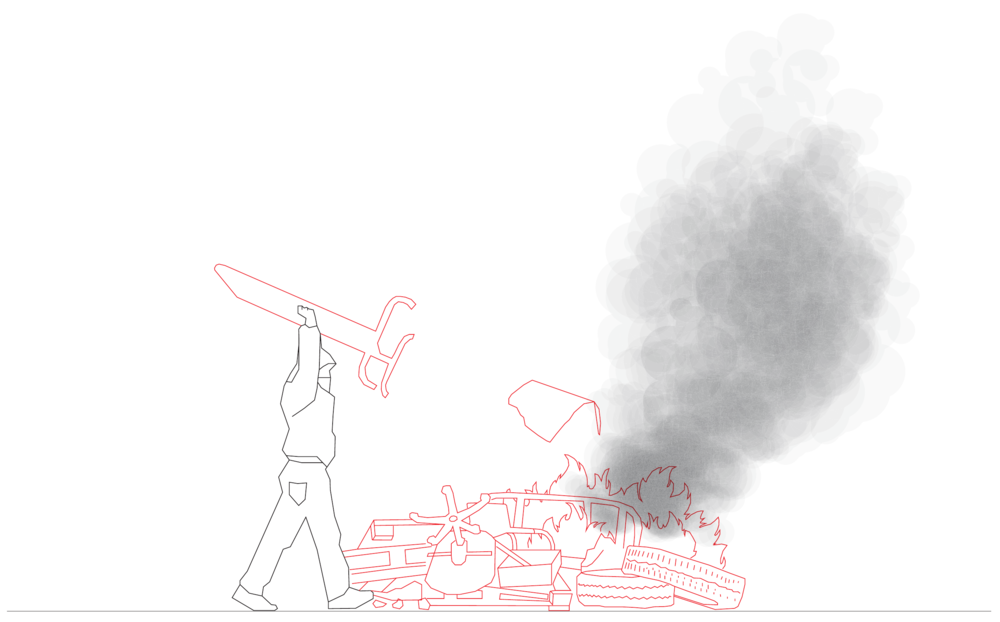
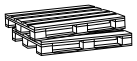
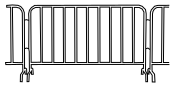
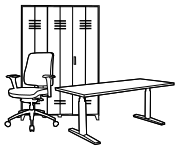
Not only Primera Línea actors participate in the construction. The barricades mainly consist of rubbish, things that can be found in the immediate vicinity (such as building site material or fences) and initially also furniture from looted shops, offices or churches. Traffic is blocked by erecting the barricades, so that there is enough space around the Plaza Dignidad, for example, to accommodate a larger crowd.
Often objects such as old car tires are used because they emit a copious amount of black smoke very strongly when burnt. This smoke can be seen from different directions, which in turn mobilizes other protesters to the site. Once the traffic is blocked, the barricades have the task of stopping the onrushing Carabineros.
They block their view with smoke and at the same time form an opaque, and thus hard to break through barrier, against the vehicles of the Carabineros. They also provide physical (visual) protection to target the Pacos with laser pointers or slingshots.
Action
Objects


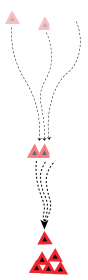
Los escuderos
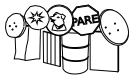
The shield-bearers
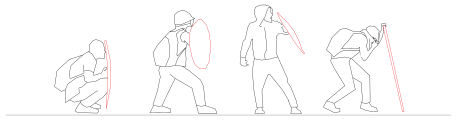
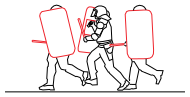
los escuderos oppose the Carabineros in the first position with self-made shields.
Specification
Although they actually take up a defensive position and do not actively attack the Carabineros, they feel the full impact of the state's force, from water cannons to shotgun pellets to gas grenades and approaching vehicles. They try to hold the position of the formation or to capture strategically important points around the Plaza de Dignidad. Their movements in space are rather static and depend on the intensity of the repression and the collective union.
They are decisive in determining whether the protest is cleared by the Carabineros on a given day, as the rest of the Primera Línea collective unites behind the shield-bearers. The bulwark is most effective when several shield bearers form formations that do not allow the Carabineros to intervene.
The shields are usually made from scrap metal and objects available in the city, such as old satellite dishes, metal barrels, street signs, corrugated iron and wooden panels. They often contain political statements, symbols of protest or Mapuche signs.
Action
Objects




Techniques


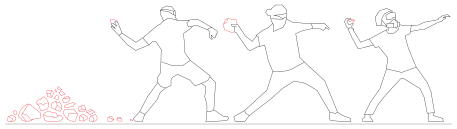
Los penasqueros
The stone-throwers
los penasqueros form the arm of the short-range combat.
Specification
Often, the protesters only resort to throwing stones at the Carabineros after they have already been subjected to violence by the Carabineros. Depending on the level of escalation, in addition to stones they will also use paint bombs, bottles, Molotov cocktails and pyrotechnics. They keep the ground troops of the Carabineros away at an arm throwing distance. Stones and other blunt objects are thrown at cops, while bottles filled with paint are thrown at vehicles to obstruct their view and render them harmless.
Since stone-throwers don't need any special props, they include hardliners who always fight in the front line as well as protesters who support the Primera Línea only situationally and briefly. The stone-throwers move partly in front of or directly behind the shield wall in energetic short cross movements to collect stones, throw them and get back into the protection of the shield. Since the chances of success with a stone become higher the closer the distance to the target, their actions become more dangerous for the Carabineros the closer they get, but are also associated with a higher risk to their health.
There is an infrastructural link between the stone-throwers and the miners, as the miners provide them with a steady supply of throwing material.
Action
Objects
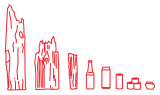

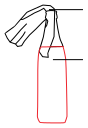

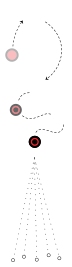
Los honderos
The slingshots
los honderos form the arm of the long-range combat.
Specification
They are responsible for ensuring that Carabineros cannot approach the shield bearers' barricades unhindered at throwing distance, for example to throw gas grenades into the formation or to break through the barricade. Different sized stones are used depending on the distance and type of sling. Since the slingers can not only shoot far with their weapons, but also have a high accuracy, they are often the primary target of the Carabineros' weapons.
For this reason, they stay close behind the shield bearers for their immediate protection. To maintain this position, they are supplied with stones too small or too large to throw. Professional slingshots and marbles as ammunition can be purchased from several vendors in the tumult of the peacefully protesting crowd. Large stones are mostly hurled at vehicles with slingshots used in teams of 3 people.
Classic slingshots consisting of a branch fork with a stretched bicycle inner tube or preserving glass rubber, professional slingshots with arm support as well as projectile launchers that require 3 people to fire are used.
Action
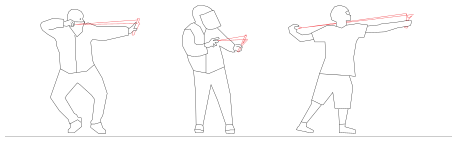
Objects
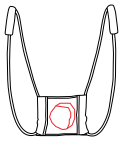


Techniques
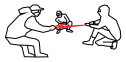

Los mineros
The miners
los mineros are the logistical supply of the offensive units of the Primera Línea.
Specification
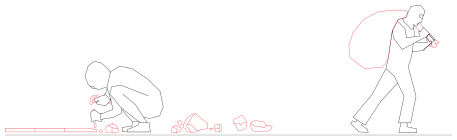
They cut road surfaces such as paving slabs into pieces of stone approximately 3-20 cm in size and transport them to central collection points near the most demanding front. Spatially, the miners are located outside the actual Primera Línea, but they represent an essential part of its infrastructure. They are located up to 100 m away from the actual front and develop more and more spatial distance to it as the quarry of the ground progresses.
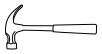
The miners work with tools such as hammers, chisels and pickaxes to loosen and obliterate the ground cover. Within this structure, however, a form of division of labor can be observed on closer inspection. In addition to the smaller groups of 3-5 people who serve as production sites for the stones, there are distributors who commute alone or in teams of 2 between the production sites and the front.
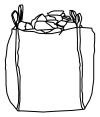
They use sacks, wheelbarrows, shopping trolleys or similar containers suitable for transporting the stones to the front line and then returning to collect new stones. The miners supply the stonethrowers and slingers with material throughout and thus make an essential contribution to maintaining the position. They are the production and distribution center for the artillery and thereby essential for the protest. The risk of danger for the miners is relatively low, as they are usually not involved in direct confrontation.
Action
Objects





Techniques

Los antigases
The anti-gas troops
los antigases are responsible for the rapid neutralization of the tear gas.
Specification
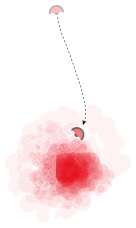
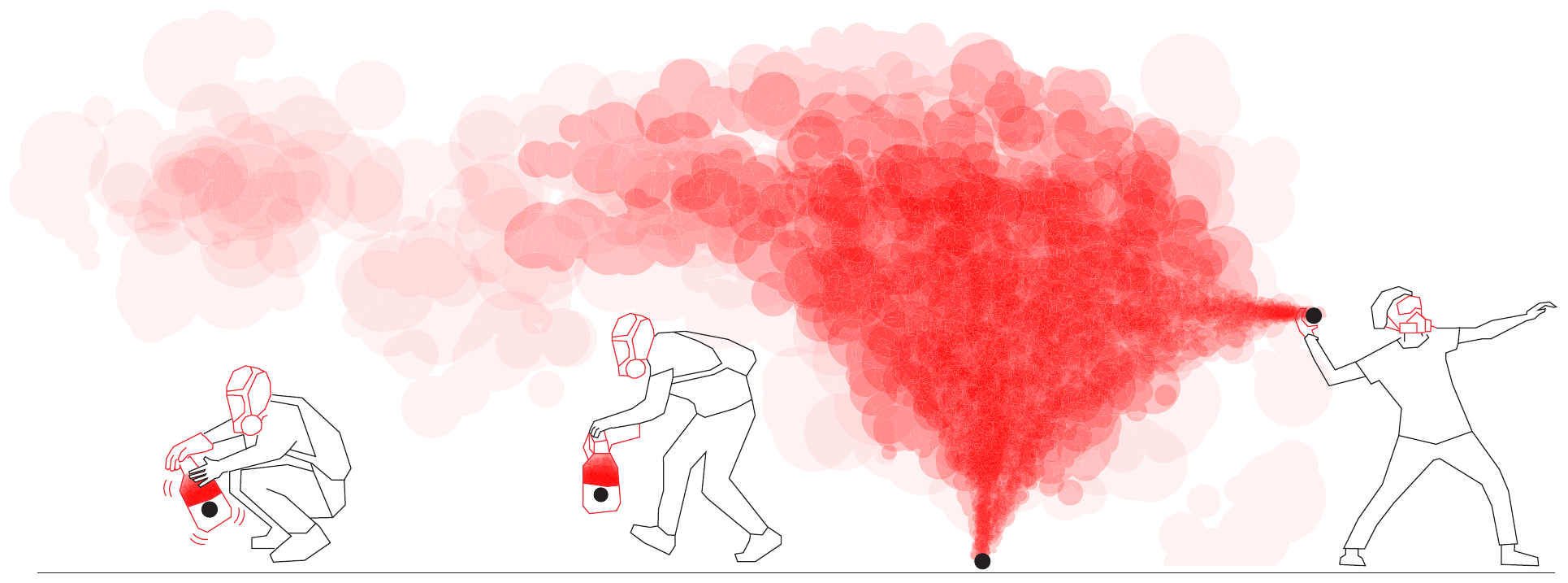
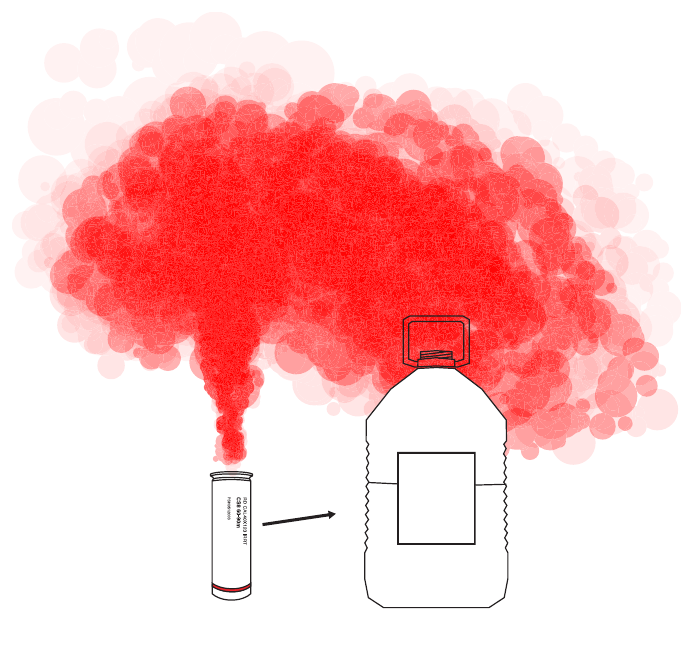
Since the gas, shot by Carabineros into the assembly, spreads in all directions, is extremely aggressive and can quickly dissolve the protest, it is crucial that this chemical weapon is rendered harmless as quickly as possible. In addition to simply throwing the projectiles back, which does not completely stop the emission of gas, the anti-gas-troops have developed techniques to stop the gas discharge and neutralize the gas cartridges.
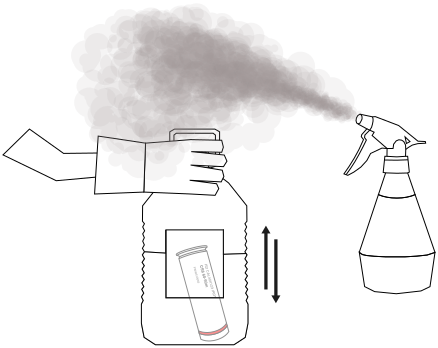
They wear gas masks, as well as fire-resistant gloves, and are equipped with 5l water canisters. The water in the canisters is laced with bicarbonate, which has the ability to neutralize the leaking chemicals. If a gas grenade strikes, it is immediately put into the half-full canister. The canister is then sealed with the fire-resistant glove and the gas grenade is extinguished by constant shaking.
Since a gas grenade can get up to 310°C hot, additional anti-gas-troops help to cool the glove. Among the anti-gas-troops there is a real race for the gas cartridges, everyone’s aim is to reach the cartridges first and render them harmless. Their movement is therefore concentrated on the impact points of the gas grenades, streaming in from all directions. Due to their operational readiness, the anti-gas-troops themselves often come into contact with the harmful gas.
Especially their arms, which are usually not covered with fabric due to the weather conditions, are exposed to the gas. For this reason, the anti-gas-troops receive support from the hydrating-troops, who treat affected areas with spray bottles filled with bicarbonate and neutralize the agent on the skin.6
Action
Objects


Techniques
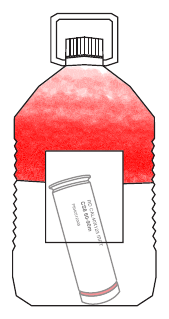
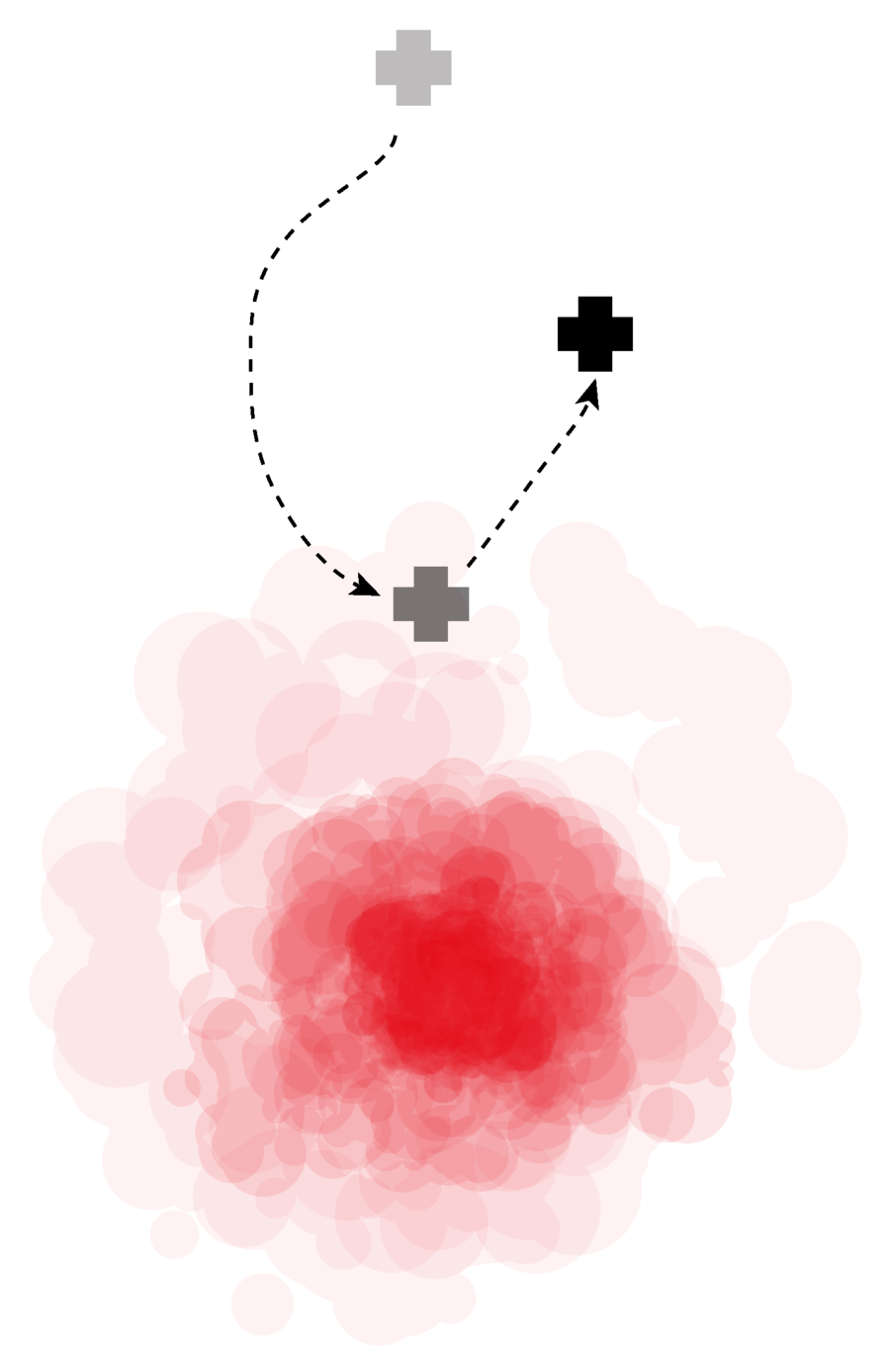
Los hidratadores
The hydrating troops
los hidratadores carry out the immediate treatment of people who have been exposed to tear gas.
Specification
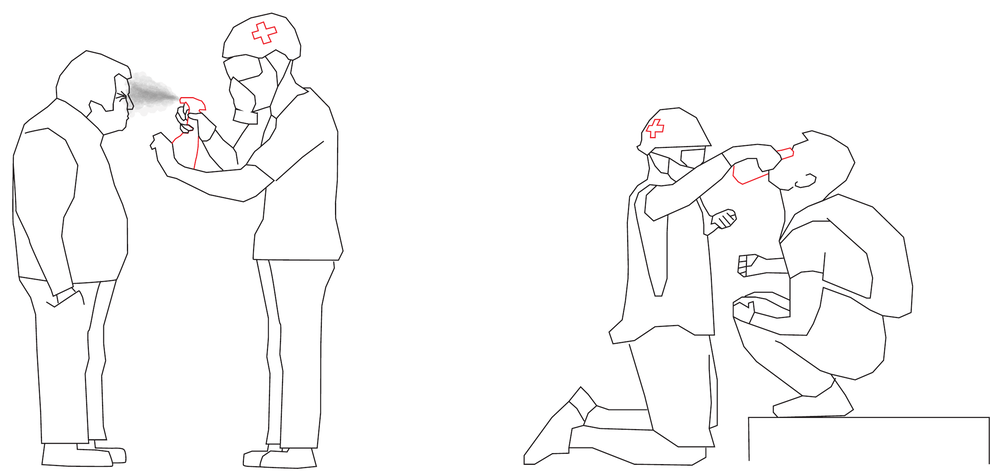
They usually stand a little secluded from the main fights and assist people who have become disoriented by the gas. Their task is to bring the affected people to safety. They wear gas masks and are equipped with spray bottles containing water with bicarbonate. This solution is sprayed on the affected person's face, or on other affected areas of the skin, resulting in symptom relief.
In addition, some of the hydrating-troops perform an initial treatment of eyes affected with gas. For this, they flush the eyes with a saline solution. By squeezing the plastic bottles filled with the solution, pressure is created, which flushes the chemicals out of the eyes and prevents more serious injuries to them eyes. The most frequent users of the hydrating-troops are the people standing in the immediate vicinity of the gas cartridges.
However, since the gas is dispersed through the air and thus affects all protesters, the hydrating-troops' field of activity extends from the frontline far into the space of peaceful protest. Here, people with watery eyes are mainly supplied with lemons, which the respective people bite on to stop the flow of tears. The hydrating-troops are in close cooperation with the anti-gas-troops, as well as the médicos and cross their paths at affected areas from time to time.7
Action
Objects


Techniques


Los médicos
The paramedics
los médicos provide medical care for anyone injured in combat.
Specification
They partly consist of civilians but mainly of medical students and doctors who provide initial treatment to injured protesters after they have finished their regular work. They are organized as a team and equipped with their own homemade protective gear, including shields and helmets, which they bitterly need. Although they are dressed in strikingly identifiable clothing as paramedics, they also often become targets of the Carabineros' gunfire during frontline rescue operations.
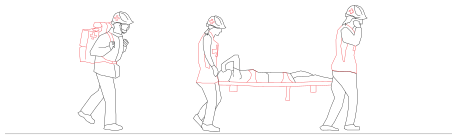
For this reason, the securing and removal of injured persons is done by civilians in protective gear. The injured are carried out of the combat zone on stretchers, in shopping carts or on their hands, where they are then treated by medical personnel in improvised treatment tents. This division of labor between civilians and medical personnel is necessary because there are too many wounded by the Carabineros and too few trained personnel who can volunteer to take care of the sometimes very serious wounds.
If a doctor is wounded during a rescue operation, the rest of the collective lacks their expertise. Since the public health system is extremely poorly equipped and private clinics are only an option for very rich Chileans, los médicos treat all injuries that are not life-threatening, including the removal of shotgun pellets in the face, directly on site.8
Action
Objects
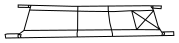



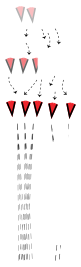
Los punteros
The laser-pointers
los punteros form the rearmost block of the Primera Línea.
Specification
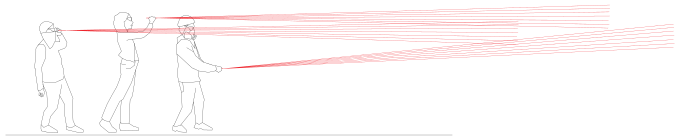
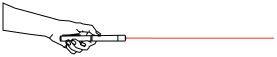
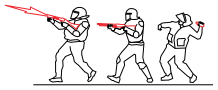
Their task is to blind the Carabineros, drones, vehicles and cameras, slowing down and preventing the evacuation of the protest. The laser pointers with high range (sometimes several kilometers in clear visibility), like the slingshots, are also made available for sale in the peaceful part of the protest. Los punteros form a very effective way with very little material to influence the movements of the Carabineros.
Especially bundled as a group in teamwork, they can effectively accomplish their goals. They are away from the line of fire of the Carabineros, disrupting their operations, but at the same time they are not part of the actively violent group. In their position, they can also quickly go underground as part of the peaceful protest. However, their actions require the protection of a tight obscured crowd, otherwise the beam of their laser pointer will quickly give away their position to the Carabineros and they will become targets.
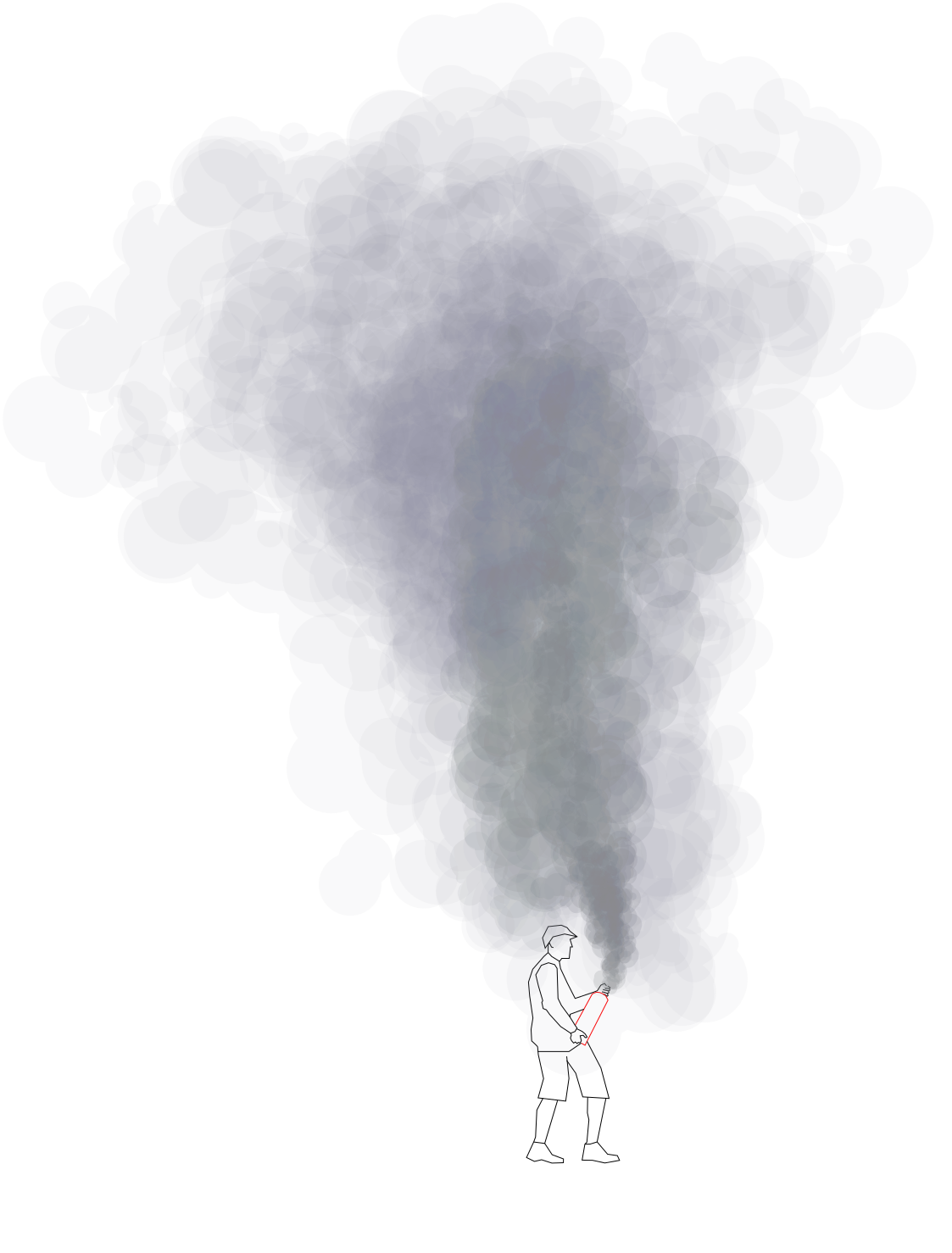
Often they are located on grass strips or minimally elevated positions, since there they do not disturb the movement dynamics of the other actors and can operate more accurately and in places with less movement. They are supported by individuals with fire extinguishers, which are not further elaborated here in our analysis as part of the Primera Línea. The fire extinguishers are emptied into the air when the Carabineros approach to create an opaque fogged atmosphere.
Action
Objects

Techniques
Los Carabineros
The Carabineros
The protesters are opposed by an armed military police force, whose founding in 1927 dates back to the first military dictatorship under Carlos Ibáñez del Campo. It is divided into the uniformed police Carabineros de Chile, the criminal police Policía de Investigaciones de Chile (PDI) and the Special Operations Forces (GOPE). Its members have ‘enjoyed’ military training and are similarly hierarchical and organized in military grades and ranks.
Although since 2011 the institution is no longer under the Ministry of National Defense but has been incorporated into the Ministry of the Interior and Public Security, the Carabineros de Chile are still considered part of the Armed Forces and can be directly integrated into the military forces in the event of a state of emergency, for example.
The Carabineros de Chile are subject to the code of military justice and internal regulations, which results in even less prosecution and adjudication for disobeying the law than this is already the case for police officers in general. In a leaked audio file from November 2019, General Director Mario Rozas also tells employees, ‘No one will be fired for police procedure.’ Furthermore, the so-called ‘Pacos’ receive a separate health and pension system that functions much better than the one for all other Chileans'.
The anger of the population at the so-called guardians of order and the homeland is understandably great. In addition to ‘Pacogate’, the largest corruption scandal in Chile's history in 2016, the systematic murder of indigenous people, leaked documents and several cover-up affairs, the Carabineros de Chile have been under massive criticism for decades, especially in dealing with protests.
Although Chile is a member of the ICCPR and the American Convention on Human Rights, the right to peaceful assembly, freedom of association and freedom of expression are systematically violated by the Carabineros de Chile. The Pacos have long been notorious for their excessive use of force. With 34 people dead, including many who lost their lives due to the violence of the Carabineros, a new negative record can be recorded since the Pinochet dictatorship, which underlines the severity.
In 2019 alone, after the protests surrounding ‘el estallido’ on October 18, there were 3,649 injuries to protesters, including 269 children, according to the Instituto Nacional de Derechos Humanos (INDH). 372 people suffered injuries or trauma to their eyes, with 33 people even losing the organ, according to the report.
The facility also registered 1,445 reported violations, with excessive use of force (842), torture and other cruel treatment (412), and sexual violence (191) being the most common. The number of unreported cases is likely to be much higher, as the population simply does not trust the police or have any hopes for investigative processes. The exalted number of people with eye injuries in the first weeks of the protest, led independent observers to conclude that eyes were deliberately shot at in order to stifle the protest with fear.9
Equipment
In addition to the armored riot gear uniform including a helmet, shield and baton, the Carabineros de Chile have resorted to other ‘non-lethal’ weapons during the protest. These include, for example, pepper spray canisters (SABRE RED) with pistol grip, but also two different CONDOR brand gas grenades. One of them bursts into 3 parts on impact, so as to affect as many people as possible with the poison.
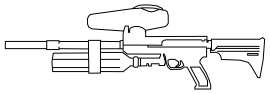
In addition, rifles (37mm launchers) are used with which similar gas projectiles with a higher range can be fired. We have also identified rifles of the brand PEPPERBALL. This weapon fires projectiles the size of a marble, encased in a robust plastic shell containing 3g of irritant gas.
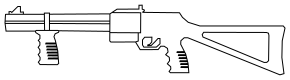
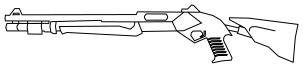
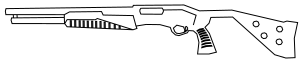
So, in addition to penetrating the skin, it also irritates the eyes of the affected persons, who often have to struggle with disorientation as a result. Especially in the first month and a half, the Carabineros also used various anti-riot shotguns loaded with miscellaneous 18mm projectiles. Even if the ammunition of these guns is called rubber bullets, these ‘non-lethal’ projectiles are not always made of solid rubber.
In the course of investigation, projectiles were identified that had a rubber content of only 20%. Besides with a shotgun, it is not possible to aim accurately, because the projectiles scatter vigorously. A person becoming a threat to the Carabineros can therefore not be rendered harmless individually, and injuries to uninvolved, non-violent persons almost always occur.
According to the manufacturers of the ammunition, it is also only allowed to fire at waist level, as otherwise the non-lethal projectiles can become lethal. However, the Carabineros also increasingly fired over the shields of the protesters, that is, at face level, which explains the frequency of eye injuries. After the publication of a report by the UN and the resulting ban on these projectiles, the Carabineros resorted to alternative projectiles, such as the so-called bean bag, which is also heavily criticized and not even listed within their protocols.
All manufacturers of these weapons and ammunition provide instructions on the ‘correct’ use of these weapons and at the same time warn about possible consequences, if the warnings are not followed.
Accordingly, gas grenades and shotgun ammunition must not be fired at face level and only at a sufficient distance. However, in many of the videos analyzed, we were able to determine that indiscriminate shooting was taking place from almost all positions and distances. In addition, we were able to observe the use of live ammunition in at least 2 videos. This also coincides with the investigative articles (Amnesty International, INDH) that have already reported on the excessive use of armed force, including the use of lethal ammunition against unarmed demonstrators. Our visualisations do not include the military who were mobilized onto the streets during the state of emergency.
Action

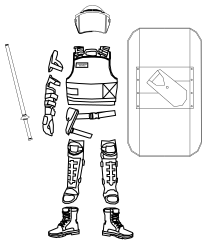


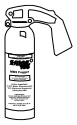





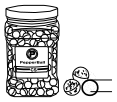
The vehicle fleet
The fundamental equipment of the Carabineros includes a vehicle fleet consisting of various vehicles that are used for diverse purposes. It is particularly noticeable that different vehicles appear in video recordings after the curfews imposed by Covid-19 than before. The most recent additions are white water cannons from a Turkish manufacturer. Apparently, the time in lockdown and the flattening of the protests was used to upgrade the police fleet.
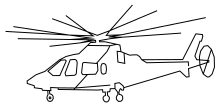
The fleet can be divided into vehicles of different types. In addition to the following mentioned in the vehicle fleet, the Carabineros have helicopters that fly over the protests on a daily basis to monitor their progress. Additionally, video drones complete the aerial footage needed for surveillance.
Both are frequently targeted by laser attacks from protesters.10
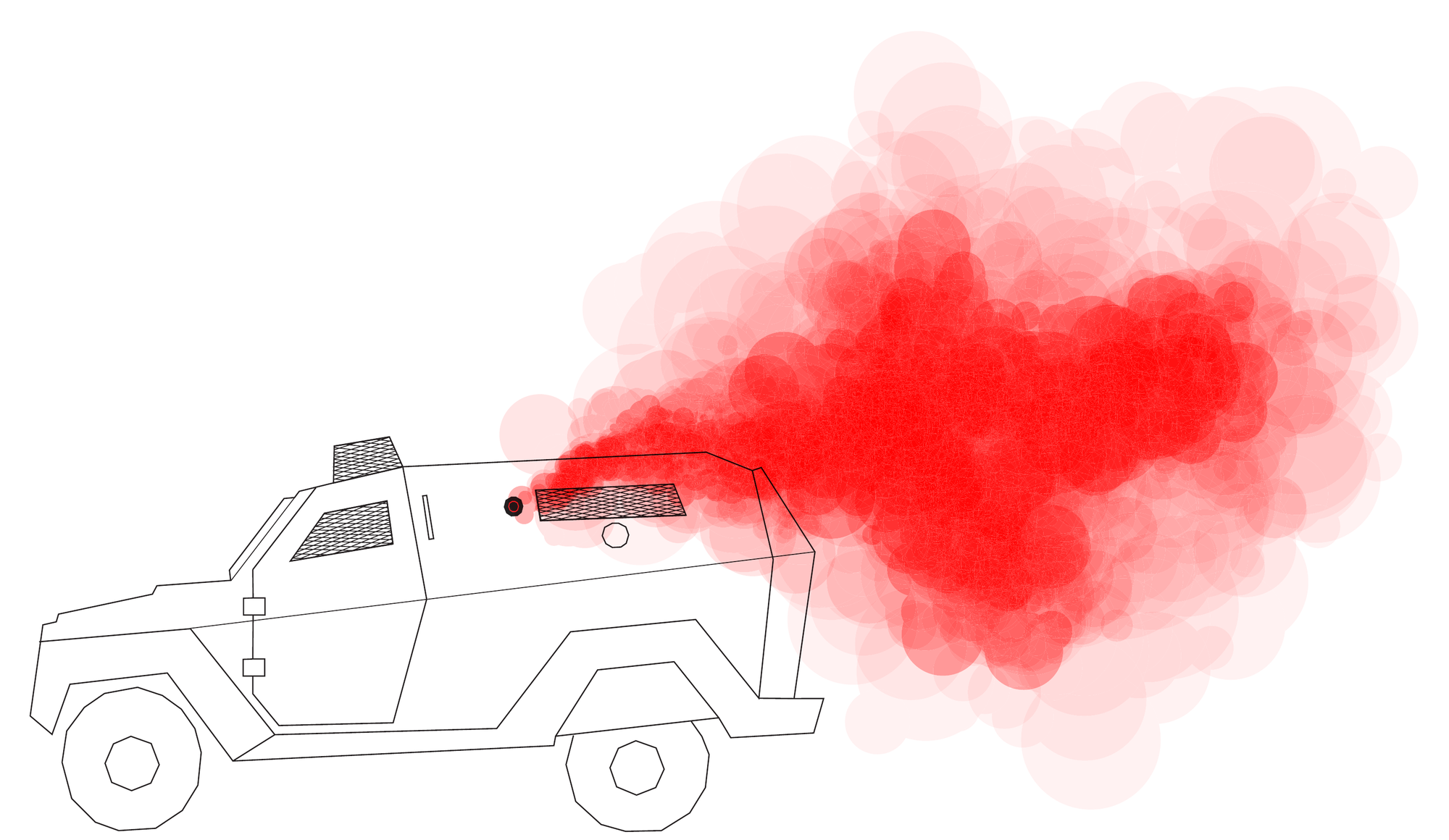
tear gas vehicles: the vehicles called ‘Zorillo’ by the Chileans are the smallest and most manoeuvrable of the 4-tire fleet. They are armored vehicles that have a hatch on each side from which tear gas flows out. The goal of the Zorillos is to disperse crowds by driving towards them and distributing tear gas in the protest space. The protesters therefore usually try to limit the visibility of the drivers (with paint bombs and lasers), to block the gas hatches or to completely disable the vehicles with Molotov cocktails. If this happens, the Zorillos enlist the help of the water cannons to clean windows or put out fires.
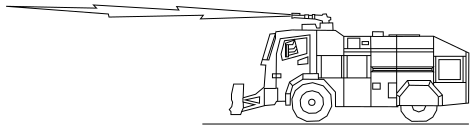
water cannons: The armored water cannons, called ‘Guanaco’, have water tanks with up to 5000l capacity. They come in different types and sizes and are used to disperse crowds with a strong jet of water and sometimes to extinguish sources of fire on other police vehicles or barricades. Some of the water is laced with chemicals and is often ‘shot' at protesters from a short distance at very high pressure. The consequences on the part of the protesters include burns on the skin to serious eye injuries.
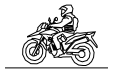
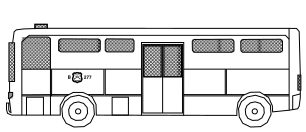
transport vehicles: Mercedes armored vans and buses are used by Carabineros as a means of rapid advance or as a fallback capacity for ground troops.11 For narrower streets or the pursuit of single individuals, the Carabineros rely on Honda and BMW brand motorcycles. In the protest, all vehicles are also used to hit or even knock down individuals.

Escenario general
The overall scene
Scroll horizontally for detail, or choose Full scene to fit the whole drawing to the page.

Movimientos y mapeos
Movements and mappings
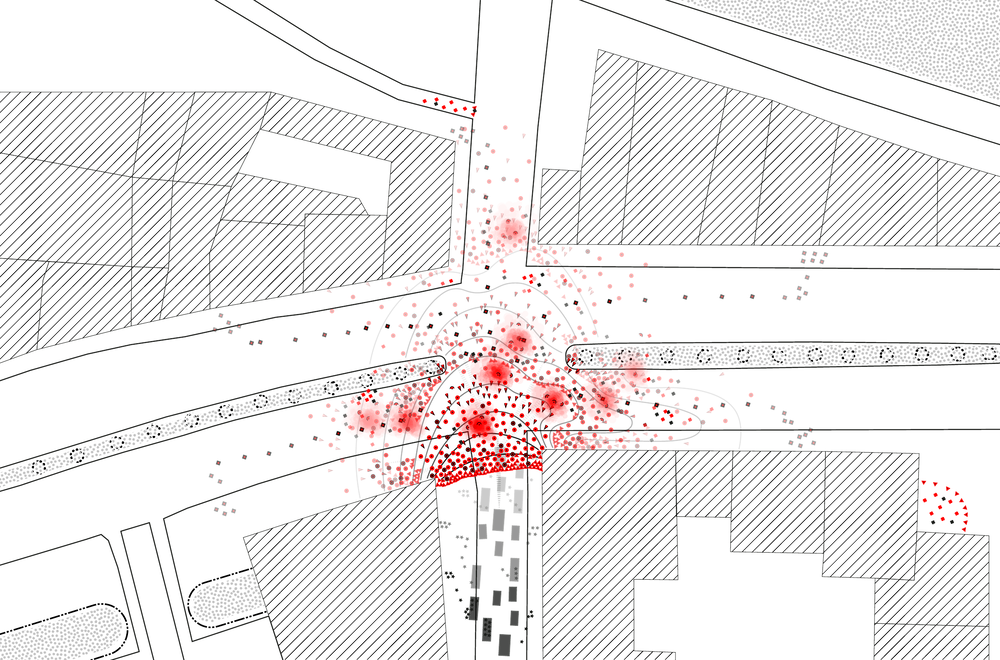
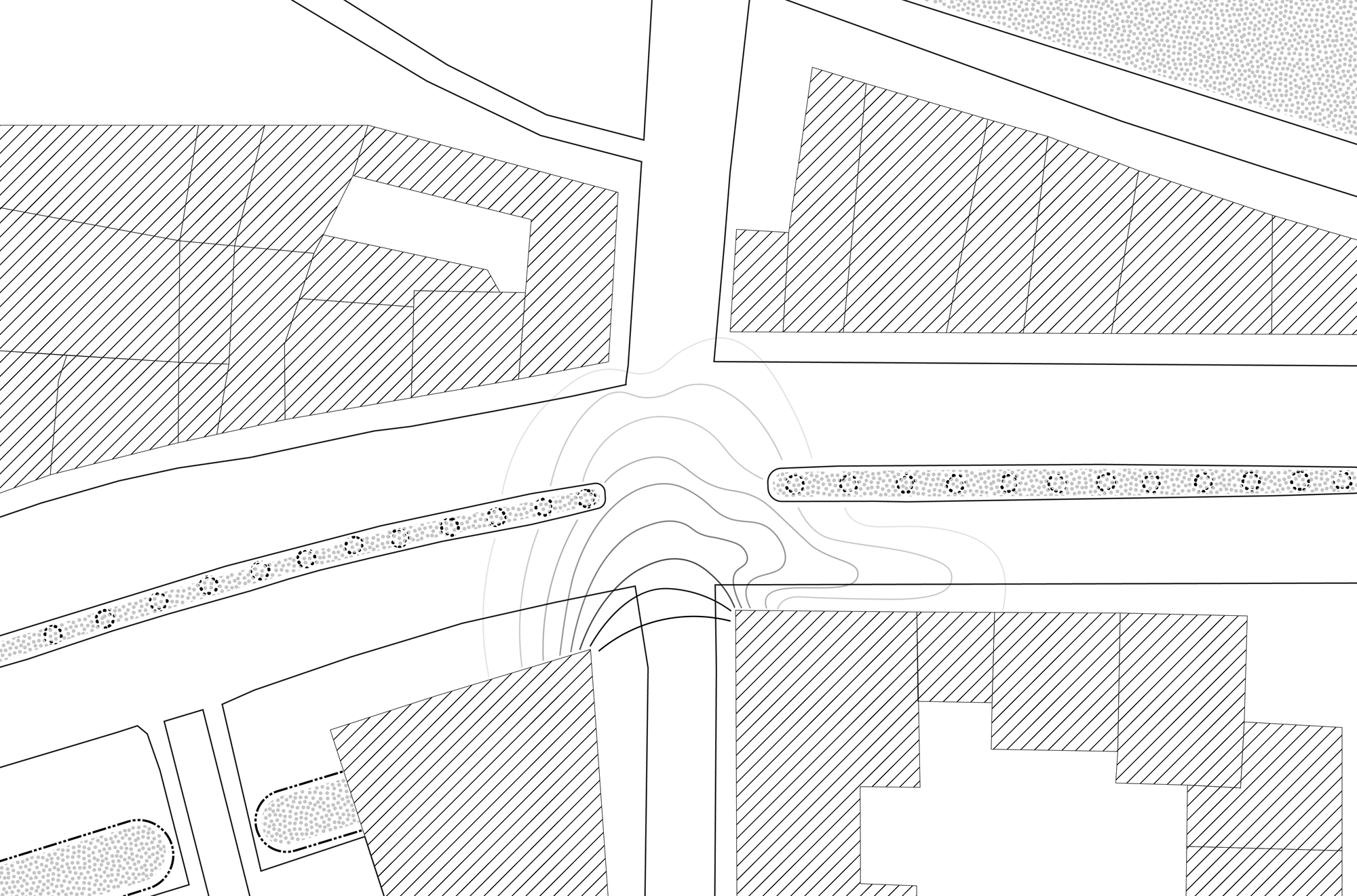
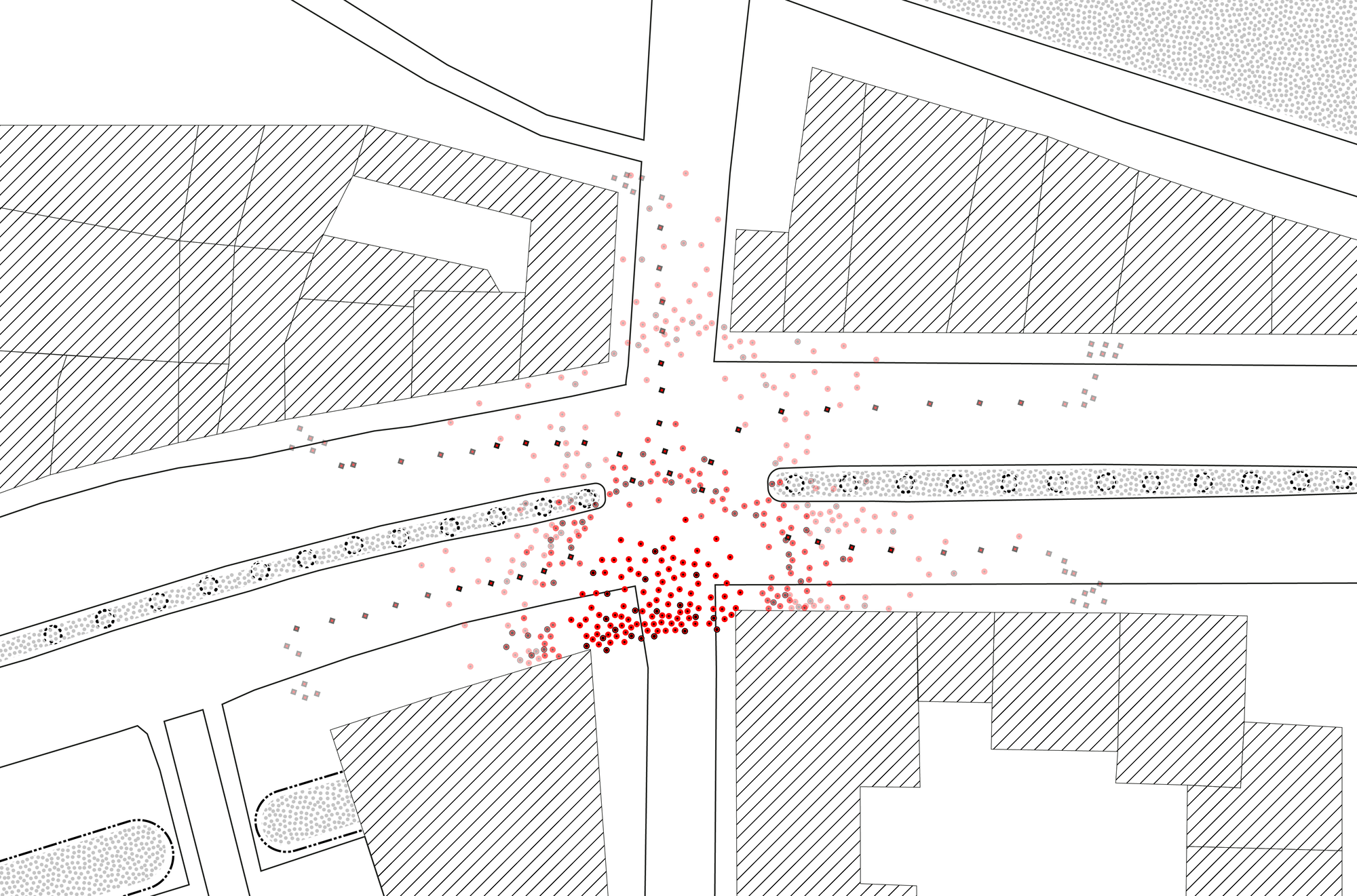
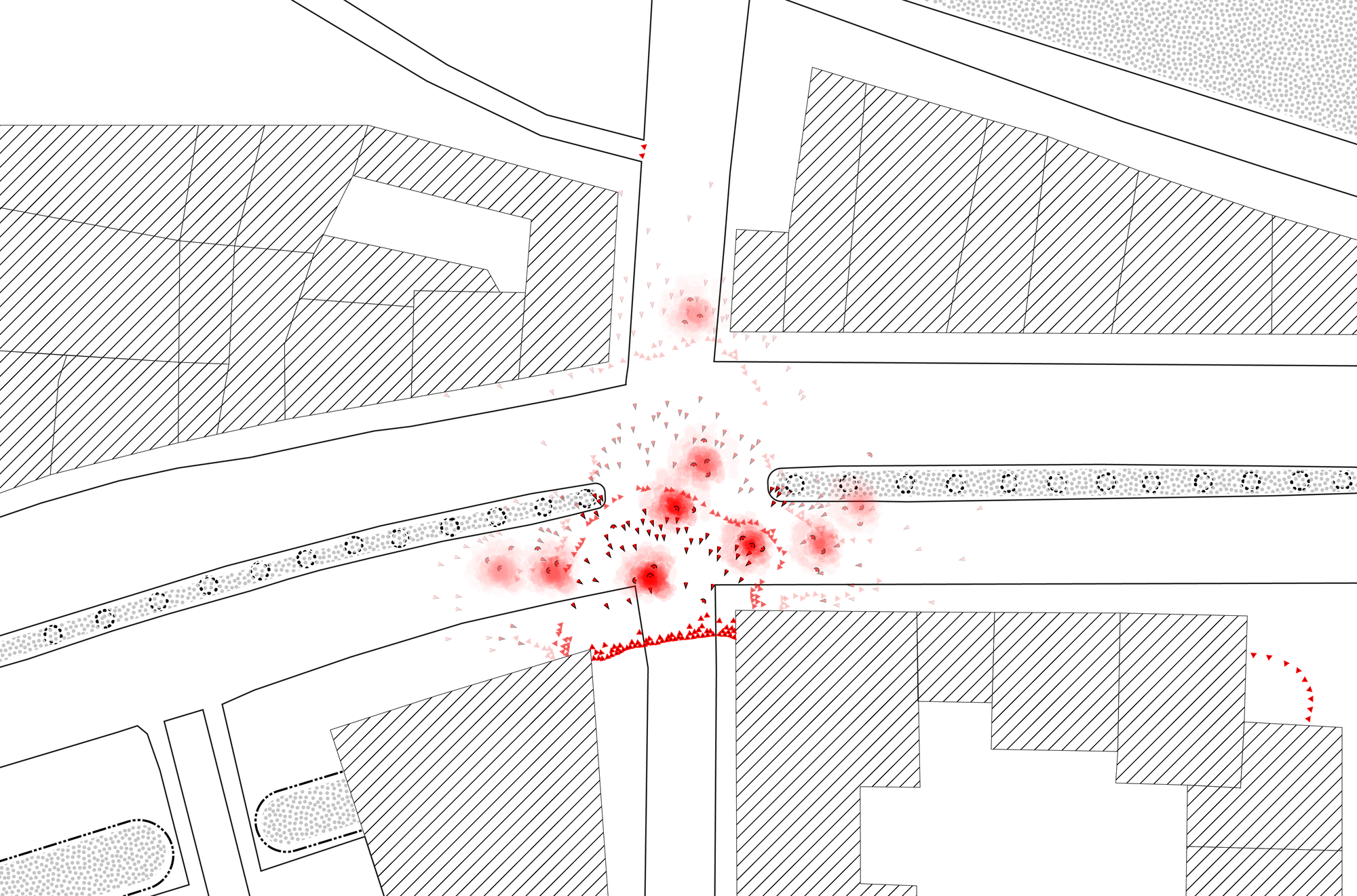
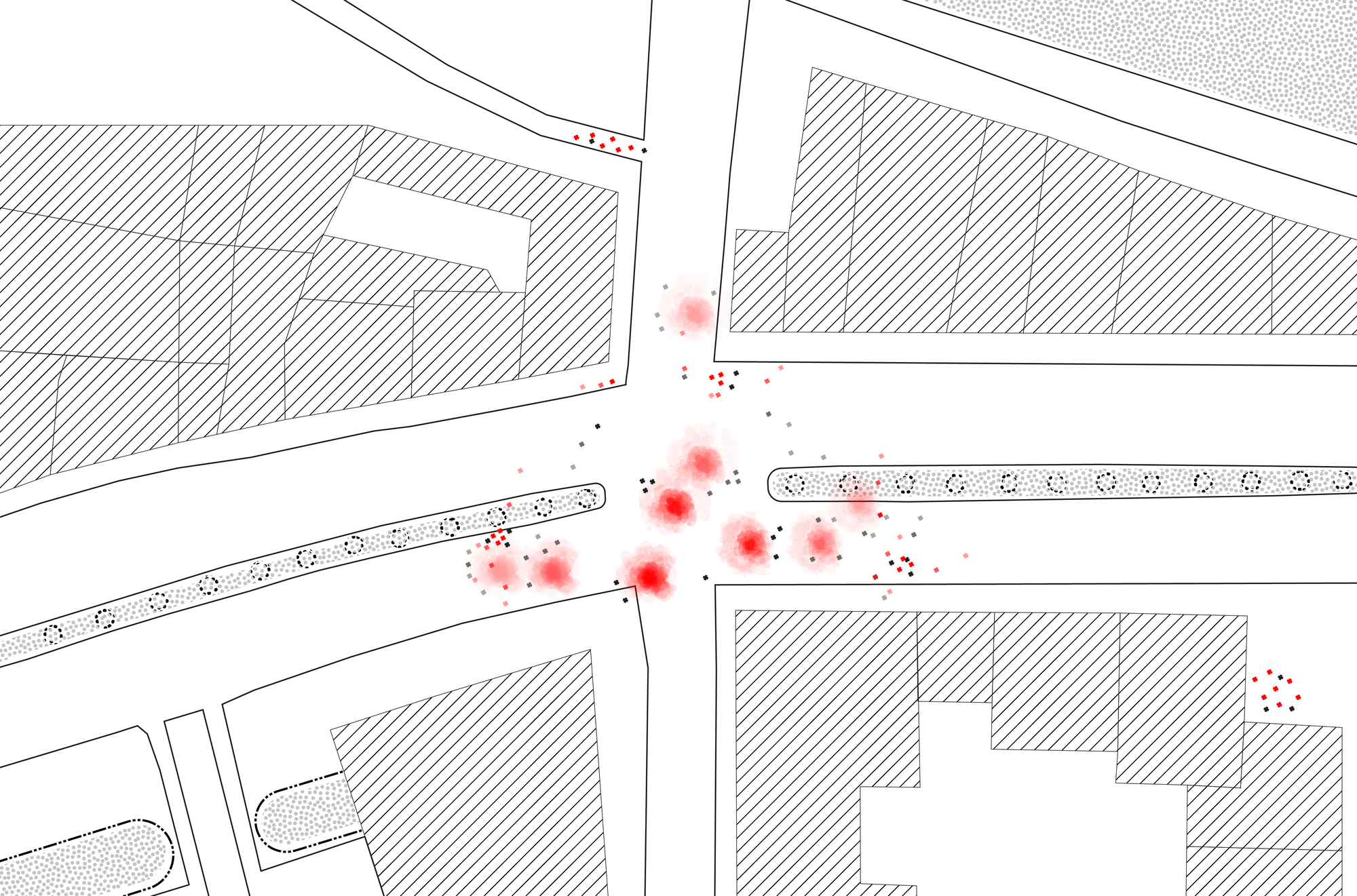
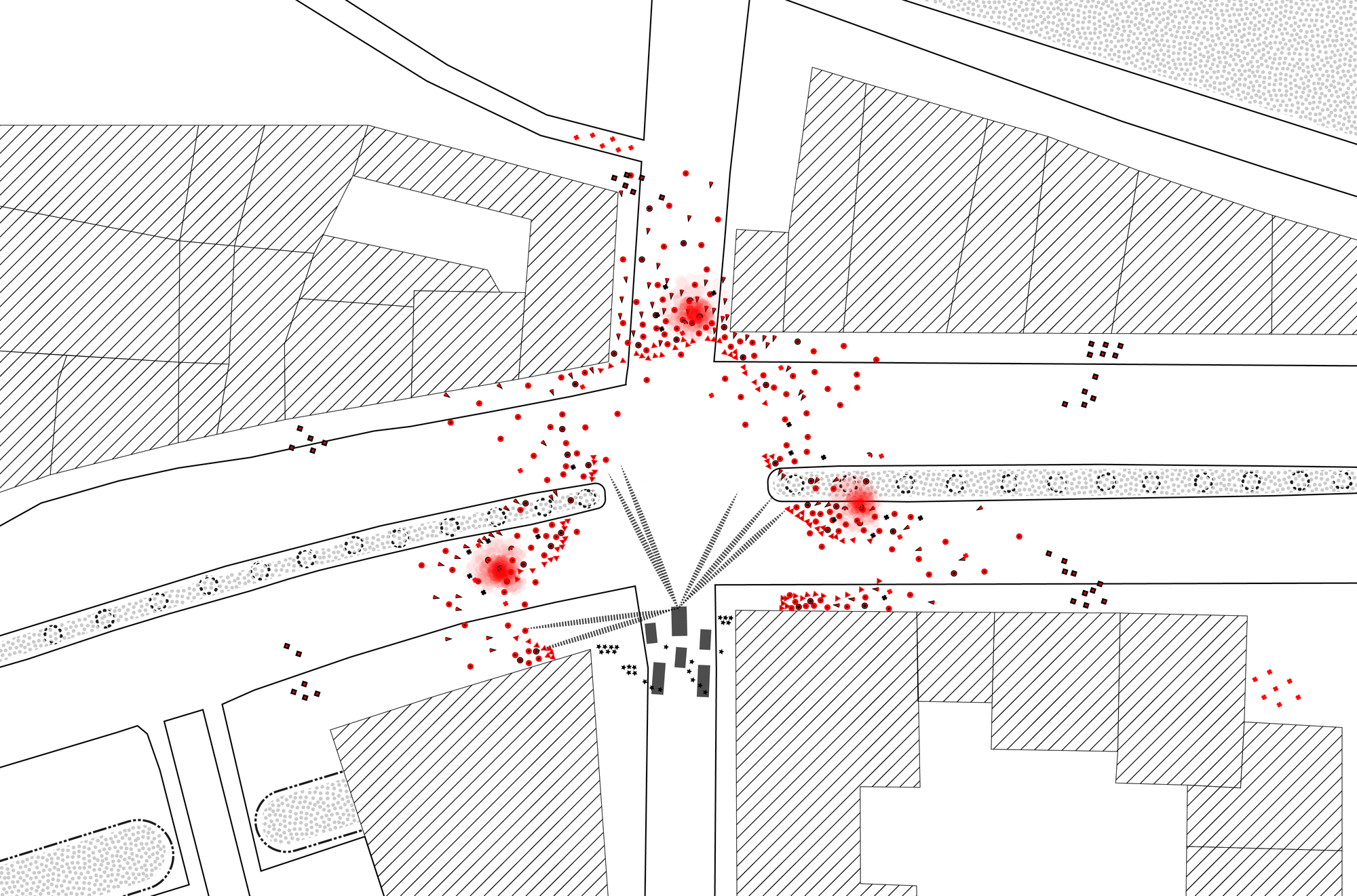
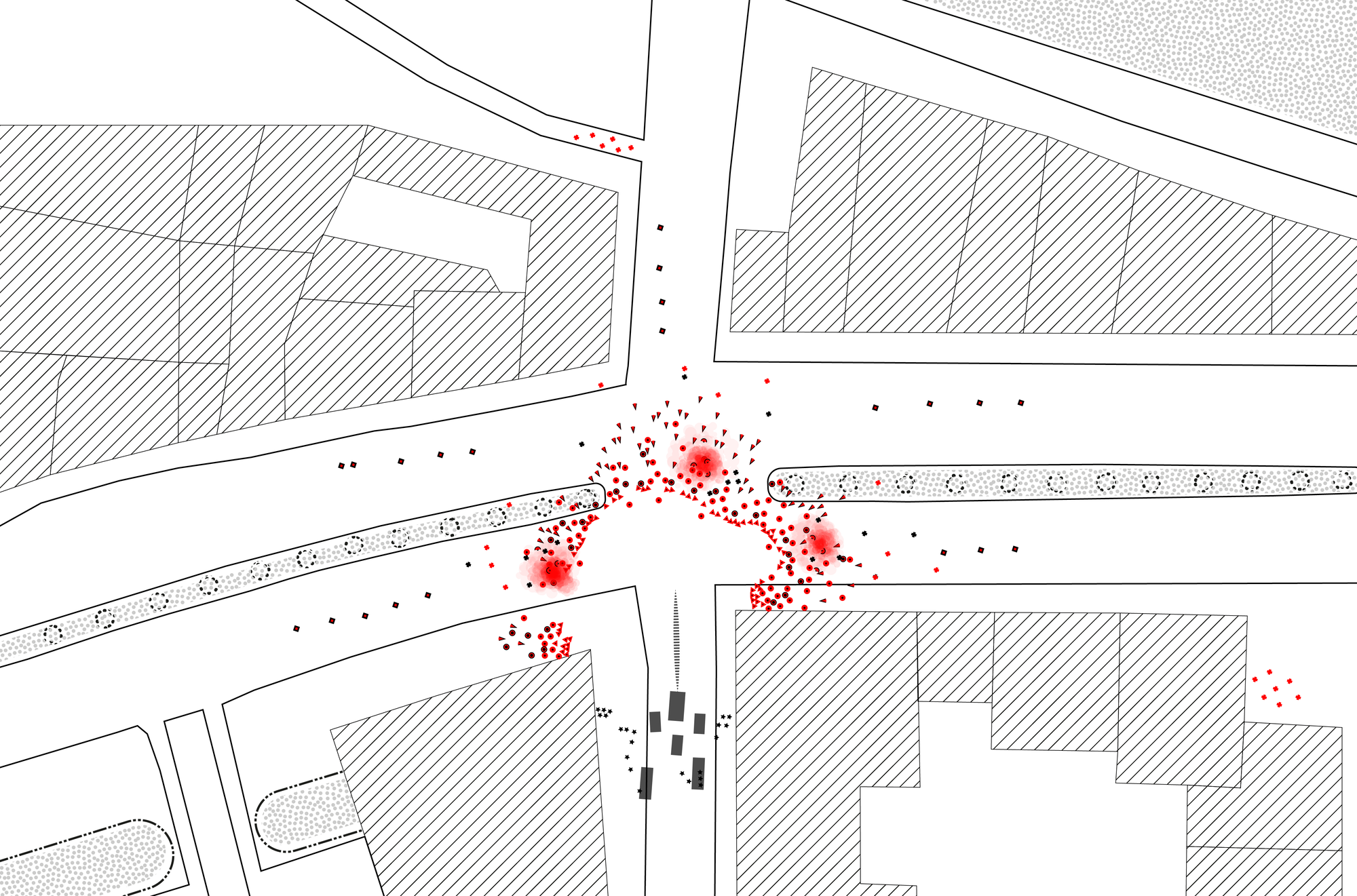
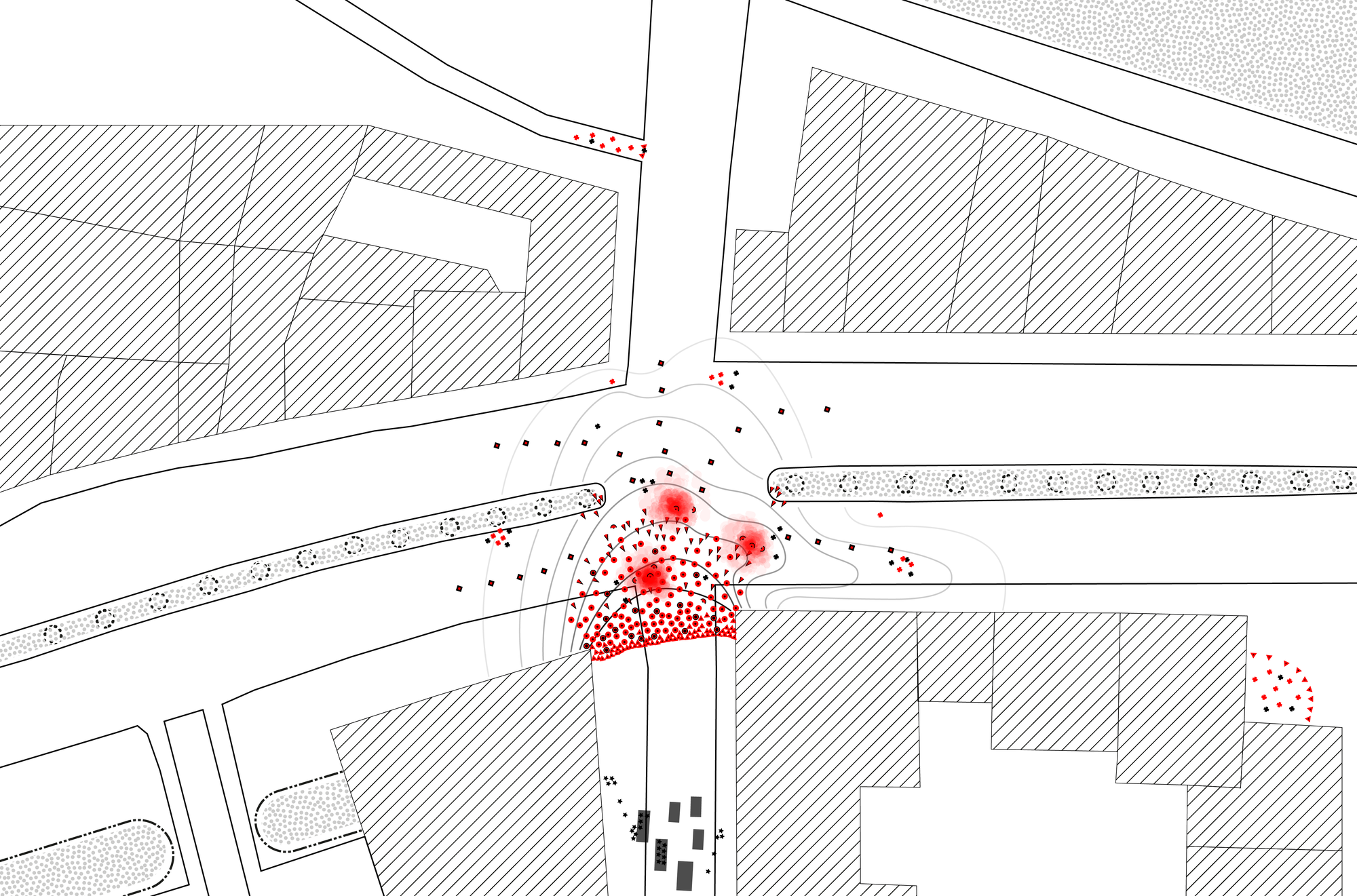
The map shows a moment in which the Primera Línea was able to push the Carabineros back into a side alley at the described location in Santiago.12 To this moment there are video sequences from different perspectives, which are partly very hectic and unclear. However, when watched closely several times, they allow us to create a schematized picture of this situation. We have drawn our analyses of the presented actors exemplary from a bird's eyes view, into the observed location. The inscribed wave-like lines show the temporal dimension, from the start of the snapshot (shown transparently) to the successful closure of the front line (shown opaquely).
The map also explains where the actors, described at the beginning (shown with different symbols) are located in each temporal phase. It also shows the place where the stones were cut from the sidewalk to defend and push back the Carabineros, and also where the medical care of the people injured in the front line takes place. In addition, it shows the movement of the Carabineros in three temporal intervals.
Reading the maps
Since the overlays of the characters result in a similarly diffuse, opaque picture as the video sequences themselves, Offense, Defense, Medical Support and the Carabineros are presented individually on the following pages. This thematic separation of the collective is intended to make the tasks and movements in the specific example easier to understand.
In order to be able to understand the movements of all actors over time, the three temporal phases can be viewed individually and once again, as an overall picture. The offensive is formed by the movements of the throwers and slingers together with the material support of the miners. The defense shows the shield bearers, the laser pointers and the antigas-troops opposing the repressions of the Pacos. On the medical support page, paramedics and hydrating troops can be observed individually, as well as their collaboration. Opposite to them is the visualization of the Carabineros, which in this particular case has to go into retreat.
Afterwards, we can look at all the actors combined in the three temporal phases that have been worked out, individually and layered consecutively . With the help of transparent paper, we want to break down the at first glance obscure tumult, in detail. The individual layers can be viewed separately or superimposed, in interaction with other actors. A white fold-in page enables a closer look at the particular view of single pages of the tracing paper.
Actor and movement key
 Los escuderosShield-bearers
 Los peñasquerosStone-throwers
 Los honderosSlingshots
 Los punterosLaser-pointers
 Los minerosMiners
 Los médicosParamedics
 Los hidratadoresHydrating troops
 Los antigasesAnti-gas troops
 Los pacosCarabineros
 Gas lacrimógenoTear gas
 Haz de cañones de aguaWater-cannon beam
 Vehículos pacosPolice vehicles
Earlier positions are more transparent; later positions are more opaque. Actor shapes and red/black marks correspond to the original legend.
All actors, La Primera Línea and Carabineros
Add or remove the original map layers. Their printed fading still represents time; the opacity control changes display strength only. Shared street ink darkens where layers overlap.
Time, all movements
Offensive
Defence
Medical support
Carabineros
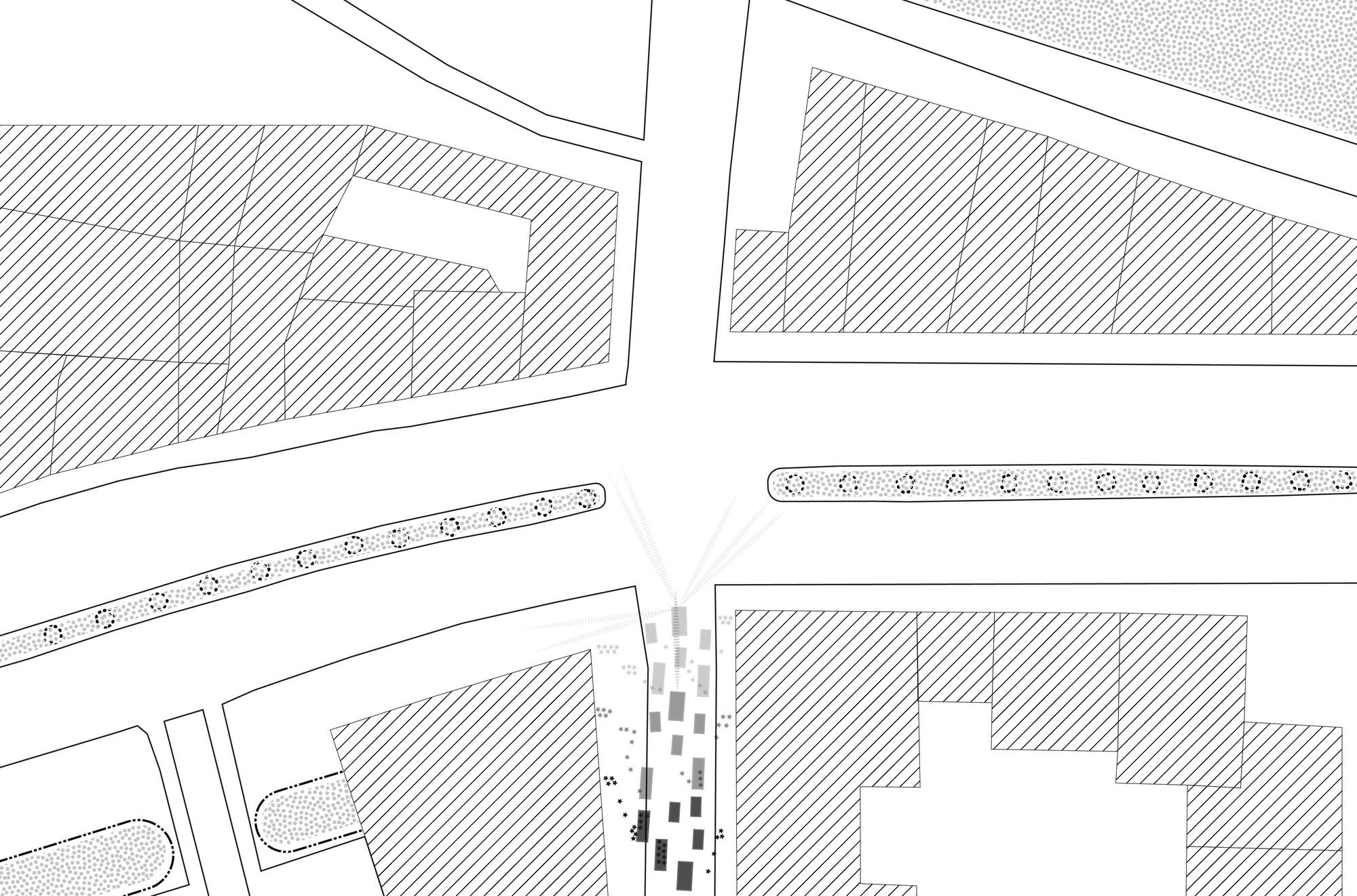
Time, phases 01 to 03
Overlay the three snapshots to compare movement through time, or select one phase to inspect that moment. Earlier phases are lighter and later phases darker. Opacity changes display strength, not duration. Shared street ink darkens where layers overlap.
Phase 01
Phase 02
Phase 03
Perspectiva
Perspective
Even after the successful referendum that led to the development of a new constitution, the protests in Chile continue. Even though the scale of the riots and gatherings of large crowds has decreased, clashes between Carabineros and demonstrators continue. It is still common to gather at Plaza Dignidad, especially on Fridays, and try to conquer the symbolic place in the struggle against the Carabineros. Even with a smaller number of people, the demonstrators succeed again and again.
The political agenda of the protesters nowadays is mainly focused on solidarity with prisoners who were arrested during the protests of the last two years. The movement demands their release as well as justice for the protesters who were injured by the Carabineros and those who died.
Even if the prospect of a new constitution could appease a broad section of the masses and bring about a return to everyday life under COVID conditions, some Chileans have doubts that the new constitution can meet their demands for a more just and social society. Since their trust in politics is very low, the next referendum will decide who will be allowed to work on a new constitution.
In the first round of voting on 25 October 2020, the people elected an ‘asamblea constituyente’, a constitutional institution composed not only of politicians but also of representatives of the people. Due to the fact that politicians have signed up for the nomination, that have previously publicly expressed their aversion to a new constitution, doubts are growing as to whether real change can be achieved.
In addition, the pandemic has Chile firmly in its grip so that no major protests can take place. This is particularly fatal in the sense that large physical gatherings are an important part of communicating and sharing knowledge with each other. The vote on who will be part of this constitutional convention will take place on April 11th, 2021.
Entrevistas
Interviews
At this point we want to give the word to voices from the Chilean people themselves. The following quotations are texts from Chilean friends, written in January 2021. We have made every effort to translate the statements according to their meaning and not to change their intention. Nevertheless, due to the editing process, individual passages may not come out with the accuracy with which the authors wrote them in their native language.
At the beginning, when it all started in the subway in Santiago, I don't think anyone could imagine what was coming. It seemed to be just another demonstration (like every year by the students), but this time it affected all of us, it was the drop that made the barrel overflow. The violence and the police repression made society unite and fight against the state, the Primera Línea was born here and became representatives of a society tired of the assaults. [...] Nothing is won, it's just the beginning of a long change, for now here in Valparaiso (a city where much was destroyed during the big demonstrations) the Primera Línea is still there, ready and waiting to take to the streets when needed.
For me, el estallido, this social outbreak was very noticeable because it showed nationally and internationally how badly the governments have acted since the end of the coup of the dictator Pinochet. The outbreak shows the reality of a country that appears perfect on the outside, but has enormous inequality between the different social classes. [...] I hope [nevertheless] that the Primera Línea will disappear at some point, because that will be the day when we can say that the struggle is over and we are a more equal and fair country.
I thank every person who participates in the front, because if they didn't take the risk of going against the Pacos, people wouldn't take the risk of going out.
People were united by the social outburst, neighbours came together in the streets and a real sense of community was seen. [...] We were able to raise something that was necessary for everyone through solidarity and joining together. Ideas were shared, decisions were made together, knowledge was broadly shared and that is what democracy is all about. I believe that self-management and community association is what will lead us to finally free ourselves from this system where capital takes precedence over human dignity. [...] The institutional and police violence has been excessive during the social outbreak and this just shows that it has ALWAYS been like this.
Now we just had the opportunity to see the true face of our executioners. And this causes great outrage, because more than a year later we still have no one politically responsible for all that has happened since October 2019, for all the violations and abuses of human rights by the repressive agents of the state. This cannot be the same as in the dictatorship of 73.
As Chileans during and after the social outbreak, we lost our fear and now society provides justice when the authorities do not fulfil their role. I feel that nothing will change [with a new constitution], I have no hope for a positive change, politicians have laws [...] with small print that they keep from us and we are deliberately deceived. [...] I believe that the Primera Línea will continue with more force, because with this pandemic the injustices have become clear not only for the most humble people, but also for the middle class, the majority of whom were previously excluded from these demonstrations.
We learned that if we want something, that we have to go out and fight, that we can't stay at home and wait for things to sort themselves out, but that things sort themselves out through fights, and for the changes. [...] My main hope with the new constitution is that it [becomes] an equal constitution that [includes] the rights of women, of sexual dissidents, of indigenous people, of people who have always been invisible as well as socially excluded.
A constitution that cares, that guarantees the rights of the land and other species, that guarantees a dignified education and pensions. Where there is not such a big gap between social classes and where power is better distributed. [...] I believe that the social outbreaks have given the community back to the people. This community that did not work well before. It was taken away from us during the dictatorship and replaced by values of selfishness and individualism.
People have the confidence that they can bring about a great change; transformation is possible. [...] The plebiscite should [nevertheless] not be idealized, because certainly important things will change, but a great change of consciousness is needed to really transform the country we have built, starting with the emergence of community and cooperation. [...] For me, real change would mean that Chile stops having a neoliberal economy, and I don't see that happening very easily. [...] [I am not afraid of more repression] because I believe that love is stronger, it is the engine of change and human transformation. [...][The Primera Línea] is part of the love that moves the world.
The great revolutions were not far from violence and barbarism, but love, empathy and a sense of unity are always present in one way or another.
Personally, I still can't believe the march on October 25, I have never seen so many people united for a common cause in my life, and it shows us that something is really wrong when all these people participate. [...] I'm pretty scared of more repression by the Carabineros. I never liked the institution, but at least I respected them before the social crisis, but since then they only manage to stir up fear and anger. [...] There are people who are still imprisoned for their participation in the marches, while the policemen who killed them are still on duty.
This just shows the corruption that exists within this institution and the incompetent justice in this country. [...] I think that after the plebiscite it will take several years to see the real changes that are expected, this is just a date that will start this long process. [...] Even in observing and briefly examining those who are running as voters, one can observe a disturbing pattern: Some of these people have spent months mocking the protests and even openly declaring their opposition to a new constitution. [...] how is it possible to make changes when in the end the same people who are already in power are writing a new constitution?
In view of the referendum on April 11, I am happy as a citizen to be able to vote for those who will be part of the process of drafting a new constitution [...] After years of injustice, a light of hope is opening for Chileans who dream of a more just and egalitarian country where, for the first time in Chile's history, women can be an active part of the process of drafting the new constitution and contribute to a constitution with feminist principles based on human rights. [...] The strong repression by the police and the military is intimidating and really scary, because they proceed with excessive violence, making no exceptions for children, the elderly or people with disabilities when they attack and injure. [...] a situation that reminded us of the actions during the military dictatorship of 1973. [That's why] there are people who are ready to fight against those who are responsible for the repression of the demonstrators and others who are equipped to help the wounded.
The Primera Línea is and will be a fundamental contribution in the demonstrations, they are the protagonists and those who carry the leadership of this situation.
The plebiscite makes it clear that millions of people want a new beginning because the previous rules were simply not fair to them. [...] The result tells us that a large majority of people are ready to think in terms of the community and not only in terms of the reality of each individual, and want to break with the brutal individualism that neoliberalism has bequeathed us.
The vote shows a population united in a common goal. Now we must move forward with greater conviction than ever before and contribute to a more inclusive society, truly for all, that excludes no one, not even the 20% who voted to reject. The next vote is more important than this one and should not be in the hands of the same old people. [...] No one knows exactly how it will turn out, but things are bad enough not to try.
Chile has woken up, has said enough and has taken to the streets, this struggle does not stop, the people have risen and this time they will not be fooled with their tricks, this time we unite and we are a people in search of a better quality of life. If the people take a step forward, the government must take a step back.
It was a surprise to learn first hand that the state controls your own freedom and can take it away whenever it wants. When business people are part of the state, this situation is even worse. Faced with this threat, people have had to band together and fight for their own lives (literally). Social welfare is an ideal that people have been dreaming of since the beginning of the dictatorship (1973) until today. [...] We distrust the politicians, so we want the people to write the changes.
The real change we seek must come from the people, from individuals organized in collectives. [...] Everyone has learned to fight from their own place and support each other's struggle, and we find strength in this collective force. [...] The Primera Línea is necessary; protests need organization and unfortunately the government has only taken protests seriously when they involve the private sector. I may try to be a pacifist, but peace is also a class privilege.
It is a privilege to deconstruct the rage of exclusion. I cannot ignore the rage of those who are trying to bring about social change. To ignore that anger would be to ignore the reality of the country. The government must take responsibility for historical injustices. [...] I believe that there is still much to do in Chile, we need to go back to the streets, we need to continue to create spaces for self-management.
However, I am confident that organized people can achieve radical change. I use ‘radical’ in its etymological sense, meaning ‘from the root.’
I try to be positive about the April 11 plebiscite. While it is a great triumph that a plebiscite has been held and that the Chilean people have put the constitution of the military dictatorship in its place, the obstacles that the current political class is trying to put in the way of the constitutional process are obvious. [...] I don't think the politicians want real change because they and the businessmen in this country are the ones who benefit most from keeping everything the way it is.
They have proven that over the years. Many politicians are shareholders and business owners, like Piñera, the current president. That is why they have changed the laws to their taste, to favor the exploitation of natural resources and workers, in addition to the privatization of basic services and education. [...] Chile is a beautiful country with great characteristics, natural and social, that with a good administration can offer a good quality of life for all its inhabitants. [...] El Estallido also helped Chileans understand that the vast majority of us all share the same fears and problems generated by the violence of capitalism and the Constitution [...].
Proof [of cohesion] is the thousands of ollas comunes - common pots [a place set up by citizens to give away food for free] that have been set up throughout the country, helping all those affected by the economic crisis triggered by the current pandemic.
I hope that the current and future political processes will simply be led by new actors, those who have historically been removed from power, to find a new common destiny as a society that includes much more vision. The fears are that the unleashed energy cannot be articulated in a way that transforms current institutionality. There are many lessons to be learned, but it depends from which part of society and from which political position you look at the issue. [...] The upcoming elections are super important, but I think the issue of the pandemic and all the complications for everyone's life and economy, don't allow for this sense of ‘historical epic.’
[Unfortunantely] we have politics with too many economic interests, that is, many families with political legacies that are only interested in their circle. [...] There will be continued repression because the state has invested heavily in weapons and anti-demonstration vehicles that are used in Santiago and also in Araucanía, where there is a very big fight for indigenous territories and political interests to exploit resources.
We went to the streets demanding dignity, and they responded with bullets, beatings, irritant gas, water with acid that burned the skin, and a series of human rights violations that remain unpunished to this day: No one will return the more than 400 mutilated eyes, no one will return the lives lost, nor have the damages been repaired, just as many people continue to be deprived of their freedom because they fight against an unjust system, because they demand to be heard.
The military is still on the streets, but the messages on the walls and the graphic records speak for themselves. [...] It is illogical that more is invested in military weapons to oppress the population than to educate and protect them. [The Primera Línea] fought against the repression of the cops so that we could march. They use their bodies to resist the oppressive force of the machine, because no revolution can be peaceful if the violence comes from a political system that is antisocial. [...] The president declared war on his own country, he wanted to silence us once again as he has done all these years, but the voices and the cacerolazos [pots being beaten with wooden spoons] were heard in all the cities, and the images went around the world.
For the same reason we do not leave the streets, but continue to fight against this repressive and ruthless system. The people help the people, with el estallido we could see that it depends on us to change things and unity is strength. [...] The repression in the demonstrations is a systematic violation of human rights and the Primera Línea is the symbol against repression. It will always be with the people so they can demonstrate freely, so I believe they will always be there to show face.
[I hope] that after the plebiscite there will be the possibility that people with criteria and class consciousness can have access to political positions and make decisions that are coherent with Chilean reality. [However, I'm afraid] that the people who get into these new positions will be corrupted, like most of the politicians who already lead this country, and that in the end nothing will change.
For example, that the unity of the Carabineros de Chile will continue to be maintained as public order, when in reality they are clearly an obsolete institution. [...] The cops represent for me an aberration, a shame of human behaviour. Their lack of empathy and their sadistic way of oppression, more than fear, cause me disgust. I am not afraid of them. But I am afraid for the people who, trying to enforce their fundamental rights, lose the most precious thing they have, their eyesight, their loved ones and their own lives in the hands of ‘Carabineros.’ [...] The front line has always been present in the protests, in the past not as organized as now.
But there have always been those who are not afraid to lose anything. On the one hand, I agree, but on the other hand, it saddens me that many on the front line are just kids, who often don't have the real goal of this struggle clear. That the only thing they do is throw rocks and destroy things without any real organization behind it, and based on that, a more than legitimate movement is judged as violent and without basis. The front line is a double-edged sword.
I think that peaceful demonstrations are possible thanks to the Primera Línea, but I also think that this can be used by the Pacos as an excuse and motive to use more violence. [...] For some reason, the Pacos always find a reason to disperse or arrest people. [...] For the cops it's a game, they entertain themselves with these scenarios, they have fun beating the protesters and the government invests in them. [...] In this, I see the rescue and I highlight the first aid brigades that are present on the front line, they are trained and they help people affected by collateral damage, I think this is a noble and necessary work. [...] I have no hopes or fears [for Chile's future], people and civilization have disappointed me (not only in Chile). [...] People will never be satisfied and change will not happen overnight. [...] I don't expect anything from politicians, or rather, I expect the worst from politicians.
I am not afraid [however], because I do not see them in my favor. [...] I have personally experienced oppression and abuse of power by [the Pacos], and although I know they shouldn't behave that way, I don't expect them to behave any differently. Their training is corrupt, they are taught and promoted to behave that way, they are puppets, violent dogs, so I avoid them and try not to cross their path or deal with them.
In an ideal world they would be honorable defenders of the people, but we are far from an ideal world.
I believe that one of the greatest lessons for the Chilean people from the social outbreak is to recover citizen power, social protest is a very effective tool of citizen power to generate change at the level of institutional politics[...] Although I don't believe in the concept of the nation-state, I believe in the power and the necessity of the collective, of connections to achieve something - we are not alone. [...] We have a recent history of dictatorship, we already know what can happen when social and political tensions increase in a critical way, authoritarianism doesn't seem to be a distant idea to silence society. [...] I would like to think that [the constitutional process] is an opportunity to create new ways of life that allow us greater autonomy from traditional politics and economic power groups that guide the country's decisions, whether through solidarity and ecological economy and self-management, capitalism must first be defeated in our minds and in our daily practice.
That's why I don't think institutionalism can bring the dignity that the Chilean people are looking for, but we can move forward in small struggles like water rights, indigenous peoples' rights, women's reproductive rights, and fair wages, etc.
So what do I expect to happen in Chile? It is the same thing that I hope will happen in the world. I want a world where affection is more important than order and ideological order. The excess of order (which leads to an unequal and bureaucratic world) puts us in vertical forms, and that is the great damage that affects the social fabric not only in Chile, but in the whole world.
I have no greater knowledge of what is happening in Chile just because I am Chilean. Chile's problem is the world's problem. It is a problem of all the people who inhabit this planet. Affective and horizontal organization is what will save us from destruction and from our own combustion. If this does not happen, there will always be war. Not only against the government, against which there will always be battle lines and lines of resistance, but among all people.
If affective and horizontal organization is not installed; if we do not allow tenderness to govern us, civilization will be nothing more than a timeline to self-destruction. Therefore, redundancy aside, a new constitution must be made of an affective and horizontal organization, and it must be, in itself, an affective and horizontal organization. Any suggestion or hint of striving for power fragments and separates everything that has been achieved and creates a loop of aggressiveness and destruction.
I think that the ‘Pacos’, the PDI, etc., are another culmination of this vertical patriarchal voracity. The sampling of power is inherent in every atom of pain and power.
We must learn to look at ourselves. We must learn to see.
Fuentes
Sources and credits
References and acknowledgements from the original publication. Dates and source titles retain the 2021 edition’s historical context. External resources may have changed or become unavailable.
Content warning: the linked reporting and video sources may contain scenes of police violence and injury. No external videos or tracking embeds load on this page.
Articles and reporting
- Alberto Arellano, Lucas Cifuentes y Cristóbal Ríos (12/11/2019) Proyectiles “bean bag”: uno de los cartuchos que dispara Carabineros no figura en su protocolociperchile.cl
- Alfred Joignant (1/5/2020) La “primera línea”: Radicalización y efectos de trayectoriacache-elastic.emol.com
- AlJazeera (10/19/2019) Chile protests: State of emergency declared in Santiagoaljazeera.com
- Amnesty International (10/14/2020) Eyes On Chile: Police Violence And Command Responsibility During The Period Of Social Unrestamnesty.org
- Amnesty International Chile (10/14/2020) Ojos Sobre Chile: Violencia Policial Y Responsabilidad De Mando Durante El Estallido Socialamnesty.org
- Angélica Baeza (10/11/2019) Evasión masiva de alumnos del Instituto Nacional en el Metro termina con denuncia en Fiscalía y medidas de contenciónlatercera.com
- Ariela Ruiz Caro (1/1/2020) The Dramatic Fall of Chile as Latin America's Neoliberal Role Modelamericas.org
- BBC (11/18/2019) President Piñera condemns police ‘abuses’bbc.com
- Benjamín Miranda, Catalina Albert y Nicolás Sepúlveda (11/11/2019) Lesiones oculares: advertencias ignoradas por 20 días podrían ser clave en querella contra Piñeraciperchile.cl
- Camilo Cáceres (11/19/2019) Crónica sobre la “Primera Línea” de las manifestaciones: Una batalla de David contra Goliattheclinic.cl
- ChileDigna (12/8/2019) Nomina de compatriotas que han perdido sus ojoschiledigno.cl
- Crimethinc (10/15/2020) Chile: Looking Back on a Year of Uprisingcrimethinc.com
- Crimethinc (10/26/2020) The Front Line - and the Line to the Ballot Boxcrimethinc.com
- Crimethinc (7/28/2020) A New Wave of Repression in Chilede.crimethinc.com
- Crimethinc (6/8/2020) Protocols for Common Injuries from Police Weaponsde.crimethinc.com
- Crimethinc (10/24/2019) On the Front Lines in Chile. Six Accounts from the Uprisingcrimethinc.com
- Deutsche Welle (12/13/2019) UN: Menschenrechtsverletzungen in Chiledw.com
- Diego Rivera (1/2/2019) A History of Abuse: Chilean Carabineros and Social Changechiletoday.cl
- Dr. Aníbal Vivaceta de la Fuente (1/8/2020) Actualización sobre el uso de lacrimógenas por agentes del estadodiariolaquinta.cl
- el Canciller (10/3/2019) 7 antecedentes de violación a los derechos humanos en Chileelcanciller.com
- Francisco Jiménez De la Fuente (8/24/2020) “No quiero ser un ícono”: la nueva vida de Gustavo Gatica, el joven que quedó ciego por disparos de la policía en las protestas de Chilebbc.com
- Gregor Kaufeisen (2/21/2020) Chile despertó! – Chile ist aufgewachtinfosperber.ch
- Human Rights Watch (8/20/2019) Chile: Events of 2019hrw.org
- Ignacio Torres (11/18/2019) Warum die Carabineros de Chile aufgelöst werden müssennpla.de
- Iván Gajardo Millas (2/1/2020) Primera Línea: quiénes son los jóvenes escuderos que defienden a los manifestantes chilenostelam.com.ar
- John Browning (11/18/2019) Rubber Bullets Used In Chile Contain Only 20% Rubberchiletoday.cl
- José Navarrete (12/7/2019) INDH actualiza reporte y cifra en 352 las víctimas con heridas oculares en protestaslatercera.com
- Katy Watson (11/7/2019) Chile protests: Concerns grow over human rights abusesbbc.com
- Luciano Veloso (12/9/2019) Escopeta Antidisturbios y otras alternativas: desentrañando las armas de Carabineros, según expertosbiobiochile.cl
- Magdalena Claude (1/6/2020) Retrato de un clan de la Primera Líneaciperchile.cl
- Manuel Acuña Asenjo (10/11/2020) Chile. El errático generalato del coronel Mario Rozaskaosenlared.net
- Mauricio Weibel Barahona (11/21/2019) Ya en 2012 informe de Carabineros advirtió que escopetas antidisturbios provocan lesiones letales y estallido ocularciperchile.cl
- Maximiliano Carranza (11/11/2019) Apuntan A Los Ojos: La Policía De Chile Deja Ciegos A Los Manifestantessopitas.com
- Michael Albertus (10/19/2019) Opinion - Will Chile Set an Example for True Democracy?nytimes.com
- Nicolás Sepúlveda (11/16/2019) Informe de la U. de Chile, radiólogos y médicos de urgencia: perdigones de Carabineros contienen plomociperchile.cl
- Pablo Cádiz (8/16/2020) Estamos pasando al olvido”: el lamento de las víctimas de trauma ocular tras el 18-Ot13.cl
- Prensaopal (10/28/2019) Chile: Recrudece la represión policial a un pueblo que exige dignidadprensaopal.cl
- Redacción MDZ Online (11/29/2019) Impresionantes videos de Chile: así avanza la “primera línea” ante los carabinerosmdzol.com
- Sabine Mehlem (8/1/2020) Der Aufstand offline und online gegen das neoliberale Modellnetzpolitik.org
- Scott A. Reynhout (11/19/2019) What exactly are the Carabineros shooting at demonstrators in Chile?scottareynhout.com
- Sebastian Medina (10/25/2019) Los mejores carteles del “estallido social” en Chileredgol.cl
- Sebastian Medina (11/13/2019) CRISIS SOCIAL: “A nadie voy a dar de baja por un procedimiento policial”: Filtran audio del general director de Carabinerosredgol.cl
- Sebastian Piñera (10/25/2020) President Piñera offers statement following National Referendumgob.cl
- Sophia Boddenberg (8/5/2018) UN-Bericht: Chilenischer Staat verantwortlich für Kindesmisshandlungenamerika21.de
- T13 (10/17/2019) Nueva jornada de evasión en Metro por alza de pasajes obliga a empresa a cerrar estacionest13.cl
- The New Yorker (10/12/2020) Chile at the Barricadesnewyorker.com
- Zeit Online (11/14/2019) “Sie schießen den Menschen willkürlich ins Gesicht”zeit.de
Further video sources
- ALMA NEGRA (12/4/2019) Zona cero 29/11/2019 ataque de los pacos chile despertó primera líneayoutube.com
- ALMA NEGRA (11/17/2019) Chile despertó 16/11/2019 aguante primera líneayoutube.com
- ALMA NEGRA (11/30/2019) Chile despertó (que se quemen) primera línea 29/11/2019youtube.com
- ALMA NEGRA (12/17/2019) Chile 2019 la fuerza dela primera líneayoutube.com
- bluesmaxx - Guitarrista (12/16/2019) Manifestantes con ondas lanzan piedras a Carabineros. Chile 2019youtube.com
- capucha_informa (10/19/2019) #PacosAsesinos // Pacos atropellan con motos institucionales a un joven que protestabainstagram.com
- Crimethinc (10/15/2020) Kids of the Plaza 2vimeo.com
- cursedin (10/7/2019) SIN RODEOS. EVASIÓN MASIVA JMinstagram.com
- Diario El Día (11/13/2019) La razón por la que manifestantes chilenos usan punteros láser en las protestasyoutube.com
- esdras online mochilero (10/23/2019) Protestas en Chile dónde está presente la DANZA REGIONALyoutube.com
- leftvision (10/18/2020) Aufstand in Chile - Sie nahmen uns alles, selbst unsere Angstyoutube.com
- MS (11/20/2019) Primera linea anti yuta / Plaza de la dignidadyoutube.com
- Pasión Colocolina (11/14/2019) El que no salta es paco !!!youtube.com
- Patricia Rubio (2/1/2020) Primera línea 31 /1/2020youtube.com
- PiensaPrensa (11/23/2019) CHILE: Esto es lo que ocultan las noticias y toda la Prensa Nefasta.twitter.com
- prensaopalchile (12/15/2019) “Madre Esperame que Vuelvo”youtube.com
- prensaopalchile (3/8/2020) Represión criminal en #Chileyoutube.com
- prensaopalchile (11/19/2019) VIOLENTA REPRESION POLICIAL A UN MES DEL ESTALLIDO SOCIALyoutube.com
- PRIMERA LINEA Chile (1/17/2020) VAMOS CONCHATUMADRE Chile 10-01-2020: “Primera Línea”youtube.com
- PRIMERA LINEA Chile (12/15/2019) EL RESCATISTA AUTÓNOMO DE PRIMERA LÍNEA Chile 13-12-2019:youtube.com
- primeralineaprensa (10/12/2020) Ahora| La democracia de Sebastián Piñera en todo su esplendor.instagram.com
- primeralineaprensa (11/8/2019) Se registran enfrentamientos entre carabineros y manifestantesinstagram.com
- T13 (11/9/2019) Manifestantes apuntan con láser a helicópteroyoutube.com
- Viktor (11/24/2019) Así funciona la brigada zona cero de primeros auxiliosyoutube.com
Social media and visual sources
Acknowledgements
At this point we would like to thank everyone who has supported us in the realization of this project.
Thank you for your time, suggestions and professional expertise.